Children need.
. . THIS? standards
and practices in chld custody evaluations
CHILD CUSTODY EVALUATORS:
IN THEIR OWN WORDS
APA
Guidelines for Evaluating Parental Responsibility - parenting evaluations - child custody
IMPORTANT NOTICE: here
ANOTHER IMPORTANT NOTICE here
parenting parenting
plan or time parental rights and responsibilities for
MAIN ARTICLE see
here
This webpage is: CUSTODY EVALUATOR QUOTES at http://www.thelizlibrary.org/liz/custody-evaluator-quotes.html
AGENDAS:
Doubting
Child Sex Abuse Allegations
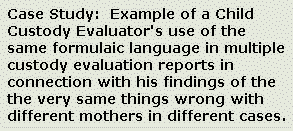 [ANONYMOUS LISTSERVE COMMENT]:
"...in my neck of the woods this is a fad whose impact peaked about
five years ago. At that time I would always have at least one case
I was working on that had vague allegations about possible sexual abuse.
At one point I was working on two cases simultaneously where there were
almost identical vague allegations made by people represented by the same
attorney. One local Family Court Judge addressed the local Family Law bar
and said that he was considering filing ethics charges against attorneys
who represented these types of allegations and the practice seems to have
slowed considerably since then. Now the new favorite allegation seems
to be domestic violence in the form of overcontrol and emotional abuse."
(New York doctorate-level MHP, December 29, 2005).
[ANONYMOUS LISTSERVE COMMENT]:
"...in my neck of the woods this is a fad whose impact peaked about
five years ago. At that time I would always have at least one case
I was working on that had vague allegations about possible sexual abuse.
At one point I was working on two cases simultaneously where there were
almost identical vague allegations made by people represented by the same
attorney. One local Family Court Judge addressed the local Family Law bar
and said that he was considering filing ethics charges against attorneys
who represented these types of allegations and the practice seems to have
slowed considerably since then. Now the new favorite allegation seems
to be domestic violence in the form of overcontrol and emotional abuse."
(New York doctorate-level MHP, December 29, 2005).
[ANONYMOUS LISTSERVE COMMENT]:
"In reviewing my posts and talking with some peers it seems to me
that a discussion of how parents inadvertently or intentional influence
children to believe they have been abused sexually and/or physically, and
if that abuse will subsequently translate into fear reactions at the mention
of the parent, and/or in response to the parent's impending or direct physical
presence may require my submission of a research paper on the matter to
a journal rather than posts to the list and evolving discussion. My interest
is in the following matters and I would appreciate any input regarding
them, including references, except in the area of suggestibility which
I think I know fairly well... " (California doctorate-level MHP, November
21, 2006).
Doubting
Women's Domestic Violence Allegations...
 [ANONYMOUS LISTSERVE
COMMENT]: "I imagine this is not a very politically correct statement,
but IMHO, if a woman stays in an abusive relationship and/or does not report
the batterer to the police, she ipso facto has issues and should
be in tx." (California doctorate-level MHP, June 3, 2001).
[ANONYMOUS LISTSERVE
COMMENT]: "I imagine this is not a very politically correct statement,
but IMHO, if a woman stays in an abusive relationship and/or does not report
the batterer to the police, she ipso facto has issues and should
be in tx." (California doctorate-level MHP, June 3, 2001).
[ANONYMOUS LISTSERVE RESPONSE]: "That's
further than I'd go, but I do think that both parents' issues need to be
assessed based on the potential impact on the children, and that this
should be the basis of treatment referrals/orders rather than an assessment
of blame for the problems in the parental relationship. I'd use the
same argument in an alienation case, i.e. that both the aligned and rejected
parents are often in need of treatment even if one bears more responsibility
for keeping the conflict going." (Another California doctorate-level
MHP, June 3, 2001).
[ANONYMOUS LISTSERVE RESPONSE]: "I
am always surprised to see how much alike the parents look - on the psych
tests - even when their presentation is different." (Yet another doctorate-level
MHP, June 3, 2001).
[ANONYMOUS
LISTSERVE COMMENT]: "80% of the men and 72% of the women REPORTED
abuse. That's similar to data from the California courts. According
to Kelly's data that she presented in Sonoma, most of the violence in separating
couples is common couple violence, not true battering. Most of them will,
as you state, end up with some form of custody, but they aren't necessarily
batterers. Also, the fact that people allege abuse doesn't mean it happened."
(California doctorate-level MHP, November 20, 2005).
[ANONYMOUS LISTSERVE COMMENT]:
"I'm involved in a case where I think an evaluator missed a case of
domestic violence because the victim came across more inappropriately in
interviews than the perpetrator did, which I believe is common and which
I believe the evaluator should have known. I'd love to have some authoritative
scientific and professional references in the literature to back up my
opinion that DV victims often appear histrionic or otherwise disturbed
while DV perps often look just fine, that anyone evaluating alleged DV
should know this, and that the evaluator should should have looked deeper
into the case. Any suggestions would be appreciated." (Missouri doctorate-level
MHP, March 17, 2007).
[No
MHP on the listserve responded. Two lawyers offered suggestions and research
citations, including to Lundy Bancroft
and an Hawaii government impact study on domestic
violence. By contrast, compare a situation in which there were numerous
responses, several excerpted here.]
and
DV advocates
[ANONYMOUS LISTSERVE COMMENT]:
"I've probably told these stories before, but... sexual abuse case,
many, many years ago, probably in the 1980s or maybe the very early 90s.
She had interviewed the child and said the child said on tape that her
father had abused her... When they were finally able to see the tape, what
she had written in the report was not in the tape. The child didn't say
what she wrote he had said. 2. In a divorce case, well after the stipulation
was signed, the woman discovered that the man had more money than she thought
he had so she wanted to reopen the case. She did this by claiming she had
been an abused wife and had signed the stipulation under duress.... ___
used this MMPI to argue that she had indeed been a battered wife. There
was no other evidence... Complaints were made by the clients to the APA
ethics committee in both cases but the APA establishment thought what she
did was just fine... And I'm sure you all know about the violence on Super
Bowl Sunday..." (Minnesota masters-level MHP, January 26, 2006).
...but
the MHP's Own Fears About Potential Violence and Perceived Threats Are
Justified
[ANONYMOUS LISTSERVE QUERY]:
"When doing a CCE you come to realize that one of the parties, if
they don't get what they want ie sole physical custody, etc, has the potential
to harm you or/and the other party. Nothing has been said, but your
experience alerts you to potential danger. Case may involve DV, ownership
of firearms, police record or gang related activity etc. which gives more
credibility to your fears. I would like to know how this has been handled
by other evaluators. How does it affect your recommendations? Do you withdraw
from the case? Do you refund money...?" (California doctorate-level
MHP FEMALE, January 17, 2004).
[ANONYMOUS LISTSERVE RESPONSE]: "I
trust my gut instinct when it comes to my safety. If I feel the situation
is unsafe... i make it safe. I terminate interviews, withdraw from cases
and do what is necessary. I rarely discuss it with the person making me
feel unsafe." (Florida doctorate-level MHP MALE, January 18,
2004).
[ANONYMOUS LISTSERVE RESPONSE]: "I
now have in my statement of understanding that if I feel violence risk
is present the parties agree to courtroom security and will pay for it."
(Colorado doctorate-level MHP MALE, January 18, 2004).
[ANONYMOUS LISTSERVE RESPONSE]: "How
do we examine potential dangerous in a custody litigant when our clinical
sense is... DANGER... how do we assess future dangerousness of a parent
who we believe might become violent upon publication of the report? What
steps do we take? How do we properly examine the situation? what variables
are relevant to examine? How do we check out our counter-transference issues..."
(North Carolina doctorate-level MHP MALE, January 20, 2004).
[ANONYMOUS LISTSERVE RESPONSE]: "when
does counter transference become life protection. don't mean to sound melodramatic.
ppl in most fields trust their instincts when it comes to protecting
themselves. Don't misunderstand. I am only talking about how to make
sure one remains safe not how one reports in a cce or other forensic evaluation...
when I feel unsafe I usually take precautions, whether this is in the custody
evaluation setting, at the mall, ordering fast food or at a sporting event."
(Florida doctorate-level MHP MALE, January 20, 2004).
[ANONYMOUS LISTSERVE RESPONSE]: "I
received my first bona fide death threat in a custody case last week...
I recognized the voice immediately... At first, I was unsure of how
fearful I should be but I admit having fantasies of explosions when
I started my car at the end of that day." (California doctorate-level
MHP MALE, January 21, 2004).
[ANONYMOUS LISTSERVE RESPONSE]: "Have
you notified the police?...Do you have an in-office alarm to the police?
Do you have a door peephole so that you can tell if the person is outside
before opening the door?..." (New Jersey doctorate-level MHP FEMALE,
January 21, 2004).
[ANONYMOUS LISTSERVE COMMENT
re being served with subpoena by a party's attorney's process server at
the MHP's home]: "After a few death threats and stalking incidents
openness to strangers at the doorstep disappears for me. The notion
of 'we know where you live' is a form of witness intimidation especially
when there is a history of intimidation, frivolous lawsuits, and chance
meetings in the community. I think all professionals should expect and
receive respect for the sanctity of one's domicile..." (California
doctorate-level MHP MALE, February 4, 2007).
[Given
some of the far-fetched and even paranoid fears of MHPs, one would think
they would have just a touch more respect, concern, and appreciation for
the fears of women who claim domestic violence and whom they expect to
be "friendly" "co-parents" in joint custody arrangements.]
False
Memory Theory
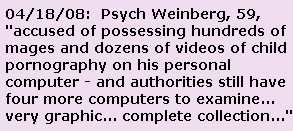 [ANONYMOUS LISTSERVE COMMENT]:
"Not only do the results fail to justify the conclusion, but the implication
of the results - namely, that false abuse memories are easily created -
is a misrepresentation of the data which is arguably unethical - which,
I understand, is why Loftus left APA before the ethical charges brought
against her reached a conclusion." (New Jersey doctorate-level MHP,
June 14, 2001). [ANONYMOUS LISTSERVE COMMENT]:
"Not only do the results fail to justify the conclusion, but the implication
of the results - namely, that false abuse memories are easily created -
is a misrepresentation of the data which is arguably unethical - which,
I understand, is why Loftus left APA before the ethical charges brought
against her reached a conclusion." (New Jersey doctorate-level MHP,
June 14, 2001).
[ANONYMOUS LISTSERVE RESPONSE]: "This
is quite typical of the Loftus et al. research pardigm. They use a subtle,
but sophisticated attempt to create false memories in their subjects. They
never are able to accomplish their goal in more than about 1/3 of their
subjects, then they try to apply their results to everyone. The more obvious
result is that despite sophisticated and subtle techniques, they are
unable to implant false memories in the vast majority of their subjects.
This is hardly good evidence upon which to base a model of memory that
posits "Memory is very vulnerable and malleable" and "The
frightening thing about this study is that it suggests how easily a false
memory can be created." What a crock." (Texas doctorate-level
MHP, June 14, 2001).
[ANONYMOUS LISTSERVE RESPONSE]: "I
went to Disney about a year ago and met many characters including Pooh,
Tigger, Eeyore, Mickey, Minney and Pluto (no Goofy that day unfortunately).
I am relatively certain of these facts, although I only have photographic
evidence of my (platonic) hug from Tigger. It is possible that Loftus et
al. could make suggestions such that I would beleive that I saw or met
Bugs Bunny or Goofy. I doubt, however, that she could have implanted the
memory that Bugs and Goofy had beaten and sodomized me while my wife was
off with the kids watching the afternoon parade." (Virginia doctorate-level
MHP, June 14, 2001).
[ANONYMOUS LISTSERVE RESPONSE]: "...if
only a third of all people are subject to being bamboozled by Loftus' techniques,
which third are they? Are they your witnesses, or the other side's
witnesses?" (New York doctorate-level MHP, June 14, 2001).
[ANONYMOUS LISTSERVE RESPONSE]: "If
the Loftus gang can get a false memory in as many as 1/3rd of their subjects,
I say 'Wow!'" ... I recognize Elizabeth Loftus as one of the leading
scientists in psychology." (Texas doctorate-level MHP, June 14, 2001).
[ANONYMOUS LISTSERVE RESPONSE]: "They
are able to create false memories in their subjects with very subtle methods.
These methods involve far less than happens in real cases in which therapists
create false memories of childhood abuse. In real cases, people are hypnotized,
put in recovered memory therapy groups, told they must not doubt their
new memories, told to read "The Courage to Heal," etc., etc...
" (Minnesota masters-level MHP, June 14, 2001).
[ANONYMOUS LISTSERVE RESPONSE]: "To
the polarized debaters of Loftus, et al. offering polemics and vitriol,
I say whoa. I obviously hit a raw spot, and the defenses have gone way
beyond my original criticism. I agree that she and those working in her
paradigm are consistently able to create false memories in 20-30% of subjects.
These are interesting findings, and of some value in forensics, interviewing
etc. However, when repeated, sophisticated, widely variable attempts to
produce an effect fail in the majority of your subjects, that calls for
an explanation. The last time I checked, and it has been a few years, no
one in the Loftus camp had attempted to explain, or even given much attention
to the resilience of memory when their own data begs for such discourse.
Also, her research has been used to impeach eyewitness testimony for years.
This is unfortunate because really the opposite should be the case. Since
she was unable to plant false memories in most of her eye-witness subjects,
it seems that witnesses shouldn't have to defend themselves regarding the
veracity of their memory, but rather, the side asserting that a memory
is false should have the task of proving such an extraordinary claim."
(Texas doctorate-level MHP, June 14, 2001),
[ANONYMOUS LISTSERVE RESPONSE]: "I
have been to several presentations by Dr. Loftus. She does not overgeneralize
her data nor does she claim that her experimental paradigms are isomorphic
with child sexual abuse situations. She does challenge us to consider how
these laboratory findings might or might not inform our judgement with
respect to allegations of sexual abuse." (Doctorate-level MHP, June
14, 2001.
[ANONYMOUS LISTSERVE RESPONSE]: "I
never said it couldn't be done. I have also evaluated quite a large number
of cases where children have made false accusations of abuse. I have
on several occasions been the one person in the system to identify such
false accusations." (Texas doctorate-level MHP, June 14, 2001).
[ANONYMOUS LISTSERVE RESPONSE]: "Frankly,
it strikes my very cynical side to ponder how, on the one hand, the discipline
strives after carefully collected observation, blah blah blah. But, then,
falls willing victim to, and publishes, argument based on fallacious reasoning."
(Doctorate-level MHP, June 14, 2001).
[ANONYMOUS LISTSERVE RESPONSE]: "Whether
one agrees with Beth Loftus' research or not, I think our responsibility
is to look at how she has moved the field forward, either through her research
or the debate it has generated. What more of a compliment to a researcher
than that she has made us think." (North Carolina doctorate-level
MHP, June 14, 2001). (How about "made us think correctly").
Taus
v. Loftus
[ANONYMOUS LISTSERVE COMMENT]:
"I'm posting an LA Times article about Loftus, her actions in a former
child custody case, and a CA
Appellate decision. I'm trying to find out if the currently "unpublished"
opinion should be disseminated, and I'm also trying to get a copy of the
letter filed by a number of psychologists seeking a CA Supreme Court Review.
Some of what she did makes me uncomfortable, but some of what Corwin did
also concerns me. I've been asked to comment on whether more of us should
become involved, and I'm seeking some feedback on that issue - and the
case in general, if any of you know more about it." (California doctorate-level
political activiooops, MHP, June 22, 2005).
[ANONYMOUS LISTSERVE COMMENT]: "From
a public policy perspective do researchers really want to add "One
of the risks of this study is that another researcher will hire private
investigators, dig through your parent's court records, and eventually
track down and contact you and your family to try and refute what you tell
us during the study" to our Human Subjects paperwork? Do *you* want
to be the subject of research knowing that is a risk?" (Texas doctorate-level
MHP, June 23, 2005).
[ANONYMOUS LISTSERVE COMMENT]: "It
seems to me that Nicole Taus has already been successful in doing a great
deal of damage to Guyer and Loftus--and the magazine? and others? At no
expense to herself. Who are her attorneys and who pays them? This is all
on contingency?... It must have cost all the defendants a fortune even
to this point where most of the claims have been denied. And it will cost
still more thru the CA Supreme Court. And then still more if that court
allows the action.. What does this mean? "offensive and objectionable"?"
(Massachusetts doctorate-level MHP, June 24, 2005).
[ANONYMOUS LISTSERVE RESPONSE]: "In
all my reading, I've yet to find something that makes me comfortable blaming
Nicole Taus for this mess... Would there not be psychological hypotheses
regarding the impact of all of these events on Ms. Taus, and her emotional
investment in maintaining certain beliefs, as well as what occurred
on the part of all professionals here, that should be considered before
focusing this discussion on the "damage" she has allegedly caused?"
(California doctorate-level MHP, June 24, 2005).
Father's
Rights (or anti-Mother) Custody Advocacy
[ANONYMOUS LISTSERVE POST]:
"Does anyone have any good references for a discussion and research
about Facticious Disorder (MSBP)? I have a case coming up ASAP where
there is a possibility that maternal grandmother has a hidden agenda to
make the child dependent." (Virginia doctorate-level MHP, June 14,
2001).
[ANONYMOUS LISTSERVE COMMENT]:
"I am in the process of recommending that the PRP be changed
in a long distance CCE (this is not a move away). The child is 3 1/2. The
psychological attachment is with the former PRP. Without going into detail,
it is in the best interest of this child to change residence. However,
there is not a safety issue in her current living situation. Her rlshp
with the other parent for the most part is good, her temperment is even
and she is mature, intelligent and loquacious for her age. She appears
to handle separation well and I am recommending she be in therapy to
help her adjust to this transition. THE PROBLEM: I don't know if it
is better to make this move gradually - adding weeks that she spends with
the new RP OR just making the change of PRP and set up the visitation plan
for other parent right from the start." (California doctorate-level
MHP, January 11, 2003).
[ANONYMOUS
LISTSERVE POST with the subject line "FYI: In Defense of Working Fathers"]:"In
Defense of Working Fathers July 11, 2005 The audio of this week's His
Side..." (California doctorate-level MHP, July 11, 2005).
[The
post included a copy of entire father's rights political webpage, containing
current editorial newsletter. During the nearly six years this author monitored
the listserve in question, father's rights editorial positions periodically
were posted by listserve members and administrators as "interesting"
or "informative" and almost invariably without criticism. There
was not a single instance of a laudatory posting of comparable editorial
material in favor of mothers' positions.]
[ANONYMOUS LISTSERVE COMMENT]:
"I haven't seen any research on this... However, in 20+ years of experience
working with divorced families, I have no doubt that fathers who were pretty
hands-off during the marriage become much more active and involved during
the divorce and that, fortunately, many of them sustain this involvement
in the post-divorce period... cynical dads who are concerned with punishing
their ex, using the children as a bargaining chip, or reducing their exposure
to child support [are unlikely] to convincingly and consistently sustain
such playacting for any period of time." (Michigan doctorate-level
MHP, April 2, 2006).
[ANONYMOUS LISTSERVE COMMENT]:
"...the other type of conference I've been attending over the last
several years has to do with the explosion of fascinating neuroscience
research utilizing all the brain-scanning technologies" (California
doctorate-level MHP, February 13, 2007).
[ANONYMOUS LISTSERVE RESPONSE]: "Great
idea! ANYTHING but another DV workshop!!! I would suggest sending
your idea to the president of the AFCC-CA chapter or even National."
(California doctorate-level MHP, February 13, 2007).
[ANONYMOUS LISTSERVE COMMENT]:
"It is patently stunning to me that we are debating the importance
or salience of father's involvement in their children's lives. The research
over the past 40 years (and no, I'm not going to cite it here)... If
we are going to debate the importance of father's involvement in their
children's lives, shall we also debate: The efficacy of women in the
workplace. The relative intelligence of African Americans. The benefits
of institutionalization for the mentally retarded. The benefits of the
man-boy love association." (Doctorate-level MHP, March 7, 2006).
[ANONYMOUS LISTSERVE COMMENT]:
"I need recommendations on the following overnight visitation case.
Context of Warschak article and new dialogue on issue. Parents never married.
Had a 4 mo. relationship. Mo got pregnant and moved in with father to be.
She got mad and left. Went to live w parents where still resides with child
who now is one y.o. Father made clear his desire to be involved with child
but insisted on DNA test after child born. She is still mad about that.
Mo. refused to let fa in delivery room. did call him day of birth and he
got see. Mo not allow further contact for about a month. She left state
for two weeks after birth. Mo. was very stingy about allowing contact.
Fa got attorney and only supervised for 1 hr in mo's home allowed. First
once a week and then twice. With a court date contact remains all supervised
in her home with two one hr visits T & TH and then a two hr on Sat.
There are no risk factors to not allow father to be involved. He is committed,
seems sincere, and very eager for longer parenting time including overnights.
Mo doesn't really see, though she'll give lip service to, the value of
the father to the child. Her possessiveness has prevailed and controlled
the situation. Oh, mo also wants to relocate from CO to CA to become an
"organic gardner." All of her extended family is in home community.
She has no job. Thinks schools would be better (Waldorf school?) in Santa
Barbara and just loves it there. An old b.f. is there. She lived there
for a while. So the question is how to increase father's parenting time?
Overnights right away. How to phase into and then want schedule would you
propose. I observed the son with the father and they did well and cried
when mother showed up. Mother is very controlling and maybe has genuine
"Mother separation anxiety" - "I've never been away from
Jack for more than an hour." Mother has started with baby food in
addition to breast feeding. Now I know Joan Kelly says breast feeding is
no impediment to allowing overnights with father ("that's what breast
pumps are for"). The relocation issue is not much of an issue (what's
that post-Burgess case on the mother wanting to move to FL to study para-psychology?).
Thanks for suggestions." (Colorado doctorate-level MHP, April 12,
2002).
[ANONYMOUS LISTSERVE RESPONSE]: "How
did you get my case file??? LOL - This almost perfectly describes one of
my current cases. Amazing how each case is seen over and over and over
again. I will be following this with great interest!" (Louisiana masters-level
MHP, April 12, 2002).
[ANONYMOUS LISTSERVE COMMENT]:
"Recent research J Family Psych (2002), 16, 363-376 concluded that
children of divorce do better when they have contact with grandparents.
In this research the kids saw the gp's frequently. With a bit of stretching,
you might conclude that an historically loving and involved extended
family (aunts, uncles, cousins, as well as gp's) is clearly in the best
interests of children, so therefore, removal of that extended base of security
by relocation is not in the best interests." (Texas doctorate-level
MHP, January 27, 2003).
[ANONYMOUS LISTSERVE RESPONSE]: "Recent
case: mo wants to relocate with three school age boys to KY saying she
wants to go to nursing school and/or get a better paying job. Her uncle
is in community but the boys can't remember who he is. Her parents are
deceased. Her sister and friends live 150+ miles away from the new community.
In the old communty are the paternal grandparents and an uncle who the
children know very well and do lots with. So it seems like a nobrainer..."
(Colorado doctorate-level MHP, January 27, 2003, who in other cases has
opined against relocation by mothers wanting to move back to communities
where they have extended family support).
[ANONYMOUS LISTSERVE RESPONSE]: "Isn't
it really a question of transfer of custody. Assume mom is moving no matter
what. Isn't the question which parent better recognizes and meets the needs
of the kids?" (New Jersey lawyer, January 27, 2003).
[ANONYMOUS LISTSERVE COMMENT]:
"...liz, of course this issue would not usually be the most important
one, but it can be. I have one right now where the assertion is the home
community is simply too costly for the electrician's helper to support
his kids and he can't afford child care. He wants to move home where it
is less expensive and there is extended family who can help with child
care. The data show he lives in one of most expensive places to live in
the country. It is a persuasive argument." (The same Colorado doctorate-level
MHP who opined supra, that disallowing the mother to move on similar
facts was a "nobrainer", February 9, 2006). (This very same MHP
also signed onto an amicus brief against a mother's move to her much less
expensive hometown to attend lawschool and live with her new husband and
be right near extended family.)
[ANONYMOUS LISTSERVE COMMENT]:
"I think father's argument deserves considerable credence. What
the child has had for the past 2.5 years is now her stability--it is mother,
not father, who is wanting to rock the boat. And just because the child
will be attending school now? How is that relevant? The child can presumably
get to school from either house, have friends over at either house, do
her homework at either house..." (Michigan doctorate-level MHP, June
14, 2001).
[Over
the period in which this author monitored the 200-300 member listserve,
the above stability argument was not raised by an MHP in any case that
was going the other way, i.e. moving a young child who had been primarily
in the mother's custody to joint custody or into father custody. The stability
argument was brought up solely in the context of protecting and enhancing
father's interests as well as in relocation cases as a purported "stability"
of geographical location.]
[ANONYMOUS
LISTSERVE COMMENT]: "What role, if any, do you think that a shared
legal custody arrangement has in motivating the parent without primary
physical custody to be more involved? I'd say it's a factor. (Pennsylvania
doctorate-level MHP, December 1, 2005).
[ANONYMOUS
LISTSERVE COMMENT]: "[I]n this case the father worked in another
state while the parents were together. He would be gone about half
the time. He continues to maintain a dual residence in the home community
of the boys. There is conflict. First evaluator recommended sole custody
because of conflict. And there is perpetual disagreements. Super involved
dad when he is in town. Full service parent. Two boys stay with him 8-12
days per month. So, is shared decision making reasonable even when the
parents aren't reasonable with each other. Is what parenting coordinators
are for? I think so." (Colorado doctorate-level MHP, December
1, 2005).
[ANONYMOUS LISTSERVE INQUIRY]:
"Are there published studies showing this type of arrangement is in
children's best interests? I see our custody mediators jumping in this
type of arrangement all too often all too quickly in cases where stay at
home custodial moms and out of home working dads (who are not all involved
in their kids lives) are being thrust into this plan. If mom has not worked
out of the home and dads are looking to then pay less child support and
no spousal support, how can these women ever make it out there. I know
the focus is not on the financial issues in these matters, but if moms
are at their wits end trying to survive and then become marginal parents
(often due to power/contol/DV issues), it surely affects BIC." (California
lawyer, August 14, 2006).
[ANONYMOUS
LISTSERVE COMMENT]: "The recommendation involved a joint physical
custody arrangement with an odd contingency... if the mother didn't agree
with the recommendation, then the father would automatically get primary
residential custody... this was after the evaluator had outlined numerous
reasons why the mother had serious concerns about the father having primary
custody... it appeared that the evaluator had set up the mother to agree
to a plan that she had clearly not agreed to during the entire evaluation...
" (Florida doctorate-level MHP, January 14, 2007).
[ANONYMOUS LISTSERVE COMMENT]:
" I just had a conversation with a local attorney who mentioned that
recommending equal parenting time is inappropriate and not supported by
case law... I of course just recommended equal parenting time with a 3
year old although I designated a residentaia parent... does anyone have
any thoughts as to why 50-50 parenting time would be inappriapriate..."
(Illinois doctorate-level MHP, March 29, 2007).
[Does
anyone have any thoughts as to why it is appropriate? or why the
parties had to pay thousands of dollars to this custody evaluator who has
no basis for his opinings?]
Parental
Alienation Theory
[ANONYMOUS LISTSERVE QUESTION]:
"I have a question about the literature and relapse behaviors -- the
potential for relapse of a mother who, in the past, engaged in alienating
behaviors that resulted in her children being further alienated from their
father than they already were... I am treating a mother who was sent to
me by Dependency Court for alienating her children from their father...
history of domestic violence and child abuse... case that has gone
on for almost a decade. At this point in time the mother does not need
treatment for trauma herself... I have been the mother's therapist at the
request of the presiding judge for about 3 months. After significant work
in treatment the mother has recognized how her overt and covert/conscious
and not so conscious behavior has hurt the children... The mother (and
the father) have had only monitored contact with the children since September.
The children are living with their maternal grandparents... The judge is
considering gradually lifting the monitoring for the mother... The judge
has this question of me: If the monitoring is lifted what is the chance
of a relapse in the mother's behaviors?" (California doctorate-level
MHP, January 18, 2004).
[ANONYMOUS LISTSERVE RESPONSE]: "Here
are three articles by Richard Gardner that may be of assistance..."
(Florida doctorate-level MHP, January 18, 2003).
[ANONYMOUS LISTSERVE QUESTION]:
"A quick example of this last one. I had a case a few years ago in
which two children, one in late elementary school, the other in high school--accused
their father of physically and emotionally abusing them, said they hated
him and never wanted to see him again. Mother was perfect in every way.
Members of mother's extended family strongly vilified father as well. I
saw the kids as alienated and not at all abused. I decided that the younger
child should live with father (and father's now blended family) despite
his absolute refusal and that mother's time should be severely curtailed
with him temporarily. The older child was too physically out of control
around father and intimidated stepmom too much for this solution to work
and I regretfully left him with mother. Several outside experts hired by
mother said some pretty slanderous things about me and ridiculed my methods
and my opinions, but the judge ultimately followed my advice..." (California
doctorate-level MHP, December 8, 2004).
[ANONYMOUS LISTSERVE COMMENT]:
"...8. Data is beginning to accumulate to show that no one intervention
is consistently helpful. Forget counseling when it comes to moderately
and severely alienated families. In these cases, placing the child primarily
with the aliented parent may help more often than not." (Pennsylvania
doctorate-level MHP, February 27, 2005).
[ANONYMOUS LISTSERVE RESPONSE]: "I
concur with all but #8. I believe the current thinking is that "parentectomies"
are ill advised." (California doctorate-level MHP, February 27, 2005).
[ANONYMOUS LISTSERVE RESPONSE]: "what
about mutually alienating parents" (Florida doctorate-level MHP, February
27, 2005).
[ANONYMOUS LISTSERVE RESPONSE]: "But
what about cases in which BOTH occur? I'm thinking of a scenario where
a kid has a rational reason to feel estranged, but then this is fanned
into alienation by a 3rd party?" (California doctorate-level MHP,
February 28, 2005).
[ANONYMOUS LISTSERVE COMMENT]: "I
think we should begin to educate courts that the estrangement or alienation
of a child from a parent in a complex, multi-level process with many individual,
parent-child, and family level contributors that cannot be reduced to simple
explanatory frameworks, In my practice, a child's disaffection from a parent
(expressed via visitation avoidance) is very often a complex mix of realistic
estrangement (rational, sometimes trauma-base) and irrational (the result
of internal cognitive distortions by the child or toxic contributions from
an alienating parent)." (New York doctorate-level MHP, February 28,
2005).
[ANONYMOUS LISTSERVE COMMENT]: "Myself
and ___ have identified specific behaviors leading to a definition of parental
alienation. We do make a distinction between estrangement and parental
alienation. We anticipate future publications on the results of our studies."
(Ohio doctorate-level MHP, February 28, 2005).
[ANONYMOUS LISTSERVE RESPONSE]: "The
Drozd Olesen decision tree has much to recommend it. The only element that
I sometimes have trouble with is the idea that in a case where there has
been abuse and the abused parent is engaging in behavior that would have
the effect of undermining the other parent-child relationship, that behavior
is necessarily based on fear or protection. Depending on the type and severity
of the abuse, how much mutuality there was, whether it was a battering
relationship... a case of common couple violence or a high conflict case
that escalated to violence, the abused parent may be engaging in undermining
behavior that is based on other issues - such as anger, high conflict
dynamics, or an attempt to use a single-incident as a tool in the custody
conflict." (California doctorate-level MHP, February 28, 2005).
[ANONYMOUS LISTSERVE RESPONSE]: "I
have seen several other cases in which the alienating parent was the father,
not the mother. It isn't always the mother. If fathers are doing the alienating
as much as mothers, it shouldn't be seen as a concept manufactured by the
father's rights movement. I agree that the behaviors should be described
but the term "parental alienation syndrome" avoided." (Minnesota
masters-level MHP, February 28, 2005).
Reluctance
to Believe Mothers' Allegations, but Tendency to Believe Father's
[ANONYMOUS LISTSERVE INQUIRY]:
"Can any one help with an intervention approach to the following.
Mother makes allegation of sex abuse - father gets supervised visitation
after an 8 month period of no contact, full eval done and allegation is
found to be unsubstantiated. Mom reconciles with dad 'to protect child'.
Child is about 3 at the time. Mother then believes that dad is again abusing
child and she contacts CPS, separates from dad and again there is a period
of about 8 months without contact... I have found absolutely no evidence
of any kind of abuse (except mom's undying belief about abuse occurring...
Other than, getting the child a new therapist, a new school, what kind
of recommendations regarding custody time with dad or even possible
custody change. I should mention that last time dad had no contact mom
went into a "shelter" for DV for 60 days (I can't find any
evidence of that either) and so I am concerned about her fleeing with
kid (so is dad). Dad has been able to maintain a good relationship
with child despite the limited contact and seems to have adequate parenting
ability. Any suggestions appreciated... (California doctorate-level MHP,
June 9, 2001).
[ANONYMOUS LISTSERVE RESPONSE]: "I
am going to make a few leaps to conclusions as preface for my recommendation.
I take it from your description that mother's 'belief system' is well-entrenched
and that any education about the likelihood of molest being slim to none
will fall on deaf ears. That she will be satisfied with nothing less than
father being ordered completely out of the child's life with the reasoning
that any other arrangement is a risk to the child's safety. If mother is
also indoctrinating the child to believe as she does and significantly
distorts reality, then I am also concerned about the possible negative
impact of mother's personality traits on the child's development. I have
had two parental alienation cases in which the parent fled with the child(ren).
Mom sounds like a good candidate for flight as well given her beliefs
about dad and her willingness to draw upon resources that will assist her
in keeping her whereabouts unknown. Can/will she relocate to 'protect'
the child? there is nothing in your post that suggests some form of education/mediation
would be effective for these people. assuming the above is an accurate
description of mother, and father will provide an adequate upbringing for
the child, I would consider a change in custody warranted. I would also
recommend supervised visitation for the mother in order to minimize the
flight risk. However, if the child is able to "compartmentalize"
her time with both parents, functions well despite the dynamics, and appears
to have a different/better sense of reality than does mother - especially
with respect to father - I might consider intensive treatment for the daughter
in order to bolster her ability to maintain a relationship with both parents
and then pick a schedule that is in keeping with her ability to spend time
with each of them. But I think this scenario is an unlikely one given the
depth of mother's belief system and the risk of flight." (California
doctorate-level MHP. June 9, 2001).
[The
"custody-switch to father" agenda also is overt in the above
post. Note that the ostensible reason for it, "the possible negative
impact of mother's personality traits on the child's development"
(whatever these may be, diagnosed by the responder from a few-paragraph
inquiry) cannot be substantiated by one single shred of scientific research.
Little research has tied particular parental personality traits (what these
may be in the case of the mother remain unknown here) to child outcomes.
Thus, the potential result in this case, which going either way, would
remove custody from one of the parents (albeit in the second, as advocated
by the MHP, would remove custody from the primary attachment parent), is
arguably the same, sole custody with one of the parents. In the absence
of any research (or indeed any facts presented here) upon which any "expert"
opinion can be based, this is a recommendation that is purely punitive
and founded in the responder's own biases and values. Worse, it is a choice
to place a child with a less-familiar parent who is a possible abuser rather
than with the primary parent who has possible "personality traits"
the evaluator does not like.]
[ANONYMOUS LISTSERVE COMMENT]:
"I'll give you one I ran into in an actual CCE where mom accused father
of sexually assaulting the child. Child exhibited a number of concerning
behaviors, made partial outcries that someone had hurt her. Mom, concerned,
sends child to therapy. Well meaning but stupid, stupid therapist works
with the child, focusing on sexual abuse by the father. Mom, because of
therapist, eventually comes to believe father sexually abused the child.
Mom is *mistaken* in this case, but is not lying. Therapist is foolish,
misinformed, borderline incompetent, but also not lying. Saddest thing
was the child probably had been sexually abused, just not by the father.
By the time I was able to point that out to anybody the child had been
irrevocably contaminated and we were never able to get clarity..."
(Texas doctorate-level MHP, November 20, 2006).
"Sex
Positivism" and Pretextual Nonjudgmentalism
[ANONYMOUS LISTSERVE COMMENT
in response to Missouri appellate case holding that trial court could consider
husband's exhibitionist masturbation in awarding custody of child
to wife]: "Since this would be in the area of "value" would
the evaluator defer on addressing this issue or is a conceptual sleight
of hand appropriate, saying the father had impulse control and judgment
problems." (Colorado doctorate-level MHP, January 12, 2004).
[ANONYMOUS LISTSERVE RESPONSE]: "I
think there is a difference between someone flashing at the playground
at Central Park and masturbating in a darkened porno theater." (New
York doctorate-level MHP, January 12, 2004).
[ANONYMOUS LISTSERVE COMMENT]:
"Step Dad admits to groping 14 year old female while asleep.
Both were on couch watching TV. Claims history of sleep walking etc. Appreciate
any information on this phenomenon. TIA" (California doctorate-level
MHP, January 15, 2004).
[ANONYMOUS LISTSERVE RESPONSE]: "If
you do a literature search on sleep walking you will find a fair amount
of support for a hypothesis about wierd somnabulistic behaviors, even murder.
If there is a family history and substantial personal history for sleep
walking the case is stronger." (Colorado doctorate-level MHP, January
15, 2004)
[ANONYMOUS LISTSERVE RESPONSE]: "Evidence
that would tend to increase or decrease its credibility might be found
in a sleep study..." (Michigan doctorate-level MHP, January 15, 2004).
[ANONYMOUS LISTSERVE RESPONSE]: "Here
is another reference I found: Sexsomnia:... Describes a distinct parasomnia
involving sexual behaviour... Eleven patients (aged 16-43 yrs) with distinct
behaviours of the sexual nature during sleep are described..." (Missouri
doctorate-level MHP, January 17, 2004).
[ANONYMOUS LISTSERVE RESPONSE]: "There
was a similar case recently in my locale - an enebriated man climbed into
his own bed late one evening and briefly touched the breast of a 13 year
old teen friend of his daughter spending the night before he fell into
a deep slumber... " (Illinois doctorate-level MHP, January 17, 2004).
[NOTSOANYMOUS LISTSERVE COMMENT]:
"The paraphilic "noncure" assertion seems bandied about
like a mantra. However, as best as I can determine, it is simply a concept
borrowed from AA propaganda... widely accepted uncritically... Does holding
a desire, in whatever strength, which one never acts upon, or acts upon
no longer, mean one still has the "problem?" If a "normal"
(with no Hx of deviant behavior) shows arousal as measured by the PPG to
images of nude children, is he pathological? ...seems to me a reasonable
paraphilic construct might require a mens rea AND some deviant action."
(Illinois doctorate-level MHP who usually works on the side of men accused
of sex abuse in criminal actions and child custody disputes, March 20,
2007).
[NOTSOANONYMOUS LISTSERVE RESPONSE]:
"I think there is something seriously wrong with a man whose favorite
sexual fantasies involve children. That something wrong can be described
as a personality disorder (in the developmental sense rather than the DSM
sense of overall adjustment), or a borderline personality organization
(in Kernberg's sense), or just as seriously disturbed (as I described in
my book on child abuse). That disturbance is bound to manifest in intimate
and ambiguous situations, in my opinion." (Denver doctorate-level
MHP professor, March 20, 2007).
[Over
a period of six years, while the subjects of child sex abuse allegations
as well as pornography repeatedly were raised, the rare point of view --
that a parent's sexual disorder is bound to manifest in various ways, even
if not in literal child sexual abuse as legally defined -- was never once
expressed by an MHP on the anonymous listserve of child custody evaluators.
The opinions were readily contra, however, if the disorder did not involve
sex and was a mother's disorder. See, e.g., infra.]
[ANONYMOUS LISTSERVE COMMENT
re the arrest of a noted child custody psychologist
for secretly videotaping a woman using the toilet in his office bathroom,
and masturbating to it]: "I'm
simply sad because the situation exists and life for him and his family
will be very difficult for some time." (Vermont doctorate-level MHP,
July 14, 2007).
[ANONYOMOUS LISTSERVE COMMENT]: "[]'s
workshops are the best I've ever attended. He has graciously shared his
time and materials with me. I'm stunned," (Missouri doctorate-level
MHP, July 14, 2007.
[ANONYMOUS LISTSERVE COMMENT]: "...we
should not jump to conclusions in either direction. If the charges are
not valid, an unspeakable wrong has been done to him." (California
doctorate-level MHP, July 14, 2007).
[ANONYMOUS LISTSERVE COMMENT]: "Absolutely!
These should be no rush to judgment. We know much good about [] and nothing
whatsoever about this allegation..." (Illinois doctorate-level MHP,
July 14, 2007).
[NOTSOANONYMOUS LISTSERVE]: "Stu's
alleged criminal conduct sounds incredibly flawed and not to be condoned
in any way (example he is no longer listed on the ABFP diplomate website).
Nonetheless, I remain quite concerned about him as a person and sent him
my support in that regard in an email sent yesterday..." (Colorado
doctorate-level MHP, July 14, 2007).
[NOTSOANONYMOUS LISTSERVE]: "I would
also respectfully suggest that, especially in our public comments, we express
equal concern for the alleged victims..." [FOLLOWUP]: " I'm just
noting that one of the alleged victims was reportedly a psychologist in
his office - which means that this person is also a colleague and may have
access to professional listservs. I can only imagine how it would feel
to be in her position, if the allegations are true, and then to sign on
to professional lists to see concern expressed only for Stu. I'm just suggesting
that if we are withholding judgment at this time, we express concern for
both sides." (California doctorate-level MHP, July 15, 2007).
[NOTSOANONYMOUS LISTSERVE]: "It is
appropriate to express concern and outrage for victims of crimes. It is
also appropriate to express concern and outrage for perpetrators of crimes...
In my work in the correctional system for the last three years, I have
learned a lesson that few who work outside the walls realize: perpetrators
are also victims of their own deeds. Crime is a tragedy no matter who is
involved." (Washington doctorate-level MHP, July 15, 2007).
[NOTSOANONYMOUS LISTSERVE]: "How
highly inappropriate to remove him from the ABPP website before he had
been found guilty of anything. I don't know who made the decision to remove
him, but I think ABPP people would be among the last persons to do such
a thing given their journeymen positions in our profession." [FOLLOWUP]
"I just went to the ABPP website and Stu Greenberg is still listed."
(California doctorate-level MHP, July 15, 2007).
The
last post above was a child custody evaluator who specializes in sex abuse
allegations. He and others exhibit the very common MHP confusion over appropriate
standards of proof when questionable behavior also could be a crime is
raised in another milieu, requiring for all purposes the criminal standard
of proof and a conviction, versus evidence (such as a confession) that
otherwise should be adequate in civil court to take protective or compensatory
action. Below, "overly" restrictive? Bias, anyone?
Also see Self-Protection Above All
[NOTSOANONYMOUS
LISTSERVE]: "Anyone have research on the effectiveness (if that
is even possible) of overly restrictive conditions of parole or probation
on Sex offenders? For example if a Judge tells a defendant that the
Conditions of probation (Child Porn conviction) will be that they can go
nowhere where children are present (Grocery stores, wal-mart, parks, etc).
Is there any research on whether this is effective management or whether
this has a negative impact on the probationer?" (Missouri doctorate-level
MHP, July 23, 2008).
 [ANONYMOUS LISTSERVE COMMENT]:
"Baures v. Lewis, 2001, I believe now controlling in that state, happened
to concern an older autistic child. It is another Burgess projeny with
similar misinterpretation of the relevant research, but the reasoning was
interesting. For your case, a risk assessment should focus on age of the
child, special needs of the child, and need for two involved parents..."
(Colorado doctorate-level MHP, January 21, 2003). [ANONYMOUS LISTSERVE COMMENT]:
"Baures v. Lewis, 2001, I believe now controlling in that state, happened
to concern an older autistic child. It is another Burgess projeny with
similar misinterpretation of the relevant research, but the reasoning was
interesting. For your case, a risk assessment should focus on age of the
child, special needs of the child, and need for two involved parents..."
(Colorado doctorate-level MHP, January 21, 2003).
[ANONYMOUS LISTSERVE COMMENT]:
"Is anyone out there aware of research about a sexually abused
parent insisting their child has been sexually abused even when there is
no supporting evidence?... The older daughter just turned twelve and
has blossomed early. Mom is allowing her to dress in VERY provocative clothing...
lets her do whatever she wants: stay out with her friends, not do her homework,
skip chores around the house, speak disrespectfully to adults... as long
as this child participates in nightly Bible reading with her sibs and mom.
Child is beginning to rebel when she's with dad, acting out anger with
sibs... pushing, slapping and yelling at two younger children. When dad
administers consequences, she pouts and refuses to leave her room... My
concern is that it is only a matter of time before there will be more abuse
allegations..." (Virginia doctorate-level MHP, January 30, 2003).
[ANONYMOUS LISTSERVE RESPONSE]: "Yeah.
But where did I read this. May Child Maltreatment or the Review journal
abot trauma put out by Sage. As I recall, the study found that mothers
who were sexually abused were more likely than mothers who were not sexually
abused to interpret their children's ambiguous behavior as sexual in nature.
Gee, this is off the top of my head. But, yes, there is something and it
is somewhat recent..." (North Carolina doctorate-level MHP, January
31, 2003).
[ANONYMOUS LISTSERVE RESPONSE]: "But
keep in mind that there is also some research supporting a correlation
between sexual abuse of mothers and actual sexual abuse of their offspring.
I don't think we have enough evidence to support treating 1st generation
sexual abuse as an indicator of the falseness of sexual abuse claims in
the second generation (not that you were saying this)." (Michigan
doctorate-level MHP, January 31, 2003).
[ANONYMOUS LISTSERVE COMMENT]:
"I have seen "Parent B's" whose divorce ignited more parenting
interest in them. Perhaps they inappropriately withdrew from both the other
parent and the child to avoid conflict. Perhaps Parent A has always been
the gatekeeper..." (California doctorate-level MHP, February 28, 2005).
[ANONYMOUS
LISTSERVE COMMENT]: "The self-fulfilling prophecy part is my point
vis-a-vis assumptions regarding conflict & shared parenting. A fixed
opinion either way risks fulfilling its own prophecy." (Texas
doctorate-level MHP, November 30, 2005).
[ANONYMOUS LISTSERVE COMMENT]:
"I agree that there is no research but there is nothing conceptually
to argue against a child being alienated by a NCP." (North Carolina
doctorate-level MHP, August 9, 2006).
[ANONYMOUS LISTSERVE RESPONSE]: "What
I like about Kelly & Johnston's framework is that it casts alienation
as a behavioral state in the child (the state of rejecting a parent), not
in a parent..." (New York doctorate-level MHP, August 10, 2006).
[ANONYMOUS LISTSERVE RESPONSE]: "I'm
not comfortable with this way of thinking about alienation. It doesn't
seem helpful to locate alienation "in" child or parent.
It seems to me that alienation is a three-way-behavioral-dynamic among
both parent (authority) figures and child, including the influence
by all the mediating variables mentioned by others. It is then
always the evaluator's job to help determine which parent-child dyad dynamic
is healthiest for the child." (Pennsylvania doctorate-level MHP, August
11, 2006).
[ANONYMOUS
LISTSERVE INQUIRY]: "A divorced mom wants to relocate with 3yo and
4yo kids from St Louis to Columbus, OH (approx 450 miles). She would fly
back with the kids 1Xmonth for them to have Fri-Mon with dad... Dad says
travel such as this is harmful to the kids. Does anyone know of any
literature that would address whether or not such travel could be harmful?"
(doctorate-level MHP, January 5, 2006)
[ANONYMOUS LISTSERVE RESPONSE]: "To
my knowledge, there's no data suggesting air travel is dangerous... "
(Florida doctorate-level MHP, January 6, 2006)
[ANONYMOUS
LISTSERVE RESPONSE]: "Don't leave out the question of how the child
feels about the travel. Sometimes kids travel just fine despite the fact
that we adults view the travel as a pain." (North Carolina doctorate-level
MHP, January 7, 2006)
[ANONYMOUS
LISTSERVE RESPONSE]: "Harmful how? Many people (kids and adults) find
travel stressful, but I don't know of particular research on point. Obviously,
that issue has to be weighed against contact with the other parent, benefits
from the move, and all of the other factors that come up in relocation
evals." (California doctorate-level MHP, January 7, 2006, apparently
recognizing that the travel issue could be argued in two ways, depending
upon the father's interests in different cases.)
[ANONYMOUS LISTSERVE COMMENT]:
"The research on pre-separation and post-separation involvement is
complex. Pre-separation involvement may or may not be predictive
of post-separation involvement. It's mediated by quality of
the relationship, dynamics at the time of separation, how the parenting
tasks were divided during the marriage, whether Dad was never involved
or withdrew as the marriage ended, whether Dad is "activated"
more into the parental role by the events of the divorce vs. withdrawing,
and a host of other situational factors." (California doctorate-level
MHP, August 8, 2006).
[The
comment in the post was followed by a spew of canned citations to agenda'd
psych literature, including by Braver and the ubiquitous Kelly and
Lamb, which themselves contain little or no backup for the assertion but
lots of political argument in favor of father involvement. No research
at all indicates that any of the "factors" the MHP suggests here
to be considered have been demonstrated actually to have any predictive
value, let alone in which direction they have predictive value, or even
to bear on the issue at all -- it's all complete speculation. "The
research is complex" is code for "There is no research"
or "The research and opinions are all over the place, so you can argue
this whichever way you want... here is a list of articles whose commentators
push the pro-father agenda you're looking for." Appending lists of
canned citations to literature is a common tactic of MHPs, both in the
prolific dump of pseudo-scientific pieces this community publishes, as
well as in defense of forensic assertions. Below, five months later, a
thread involving many of the same participants. The same California MHP
stands on her insistence that any alleged "intervening event"
could be argued to have so changed everything that the past is no longer
of predictive value.]
[ANONYMOUS
LISTSERVE INQUIRY]: "Can any of you lead me to some empirical evidence
in support of the generally held view that past behavior is the single
best predictor of future behavior? The specific behavior in which I
am interested in is parental neglect of children." (Florida doctoral-level
MHP, January 12, 2006).
[ANONYMOUS LISTSERVE RESPONSE]: "There
is something about your question in the nature of the snake swallowing
its own tail. You are asking for a system (i.e., a network of empirical
evidence based on inductive reasoning) to establish its own validity...
if we don't postulate on faith that the past can be used as a good
predictor of the future, then the whole concept of empirical evidence (in
any field, including the science of behavior) fails utterly and
nothing can count as such evidence." (Michigan doctoral-level MHP,
January 12, 2006).
[ANONYMOUS LISTSERVE RESPONSE]: "The
way I understand the predictiveness of past behavior is that it is predictive
of future behavior when there are no intervening events that are likely
to change it. Thus, some are tied to repeating the past, while others learn
from it." (California doctorate-level MHP, January 13, 2006).
 [ANONYMOUS
LISTSERVE INQUIRY]: "Mr. Smith is the sole wage-earner in the Smith
family. Mrs. Smith is unemployed outside the home. Mr. Smith keeps his
wife on an economic leash. When Mrs. Smith shops, whether it is for food
for the family, clothes for the children, or clothes for herself, she must
return from her shopping trip with receipts. She must also produce receipts
for gas purchased by her. She is not authorized to write checks and has
no credit cards. If Mrs. Smith acknowledges that mistreatment of her
by her husband only takes the form of the economic control described above,
is it appropriate to describe Mrs. Smith as a victim of domestic violence?"
(Florida doctorate-level MHP, January 20, 2006) [ANONYMOUS
LISTSERVE INQUIRY]: "Mr. Smith is the sole wage-earner in the Smith
family. Mrs. Smith is unemployed outside the home. Mr. Smith keeps his
wife on an economic leash. When Mrs. Smith shops, whether it is for food
for the family, clothes for the children, or clothes for herself, she must
return from her shopping trip with receipts. She must also produce receipts
for gas purchased by her. She is not authorized to write checks and has
no credit cards. If Mrs. Smith acknowledges that mistreatment of her
by her husband only takes the form of the economic control described above,
is it appropriate to describe Mrs. Smith as a victim of domestic violence?"
(Florida doctorate-level MHP, January 20, 2006)
[ANONYMOUS LISTSERVE RESPONSE]: "If
someone WANTS to be a doormat, is it the job of the law to tell them they
can't?" (California family lawyer, January 20, 2006)
[ANONYMOUS LISTSERVE RESPONSE]: "I
don't [think] our task is to define Domestic Violence. DV is a legal concept...
I do think our job is to describe abusive and negative behavior and discuss
its impact on children. Including the very important issue of 'exposure'
I see the exposure issue overlooked a great deal in CCE that I review."
(Florida doctorate-level MHP, January 21, 2006)
[ANONYMOUS LISTSERVE RESPONSE]: "At
the risk of being politically incorrect, did Mr. Smith offer a reason
for his behavior? Is it possible that the Smiths were people of modest
means and that Mrs. Smith was unable to control her spending? ...there
are two sides to every story..." (Texas doctorate-level MHP, January
21, 2006).
[ANONYMOUS LISTSERVE RESPONSE]: "This
is an example of an issue that would have to be carefully explored in
terms of its relevance to parenting. If it is limited to this kind
of issue, and to $$, one might need to be quite cautious about extrapolating
to the idea that it would be directly relevant to parenting." (California
doctorate-level MHP, January 20, 2006)
[ANONYMOUS LISTSERVE RESPONSE]: "With
a background in substance abuse, my first thought was not about the poor
abused woman, but perhaps whether the poor husband is out everyday in
the freezing rain making a living as a road worker, only to come home
to find his wife has spent every dime they have on 1) crack, or 2) QVC
"dimonique" earrings." (California doctorate-level MHP,
January 21, 2006).
[ANONYMOUS LISTSERVE RESPONSE]: "Kathy
Kuehnle would be gratified to see that almost all on this list who posted
during the discussion were mindful of alternative hypotheses (including
hypotheses that related to patterns of behavior not suggestive of bullying)."
(Florida doctorate-level MHP, January 21, 2006).
 [ANONYMOUS LISTSERVE COMMENT]:
"I'm in a case where someone thinks a 35-year-old parent may be developing
Bipolar Disorder, but not yet showing all signs. I believe affective disorders
including Bipolar often do develop in the 30s or even 40s, but I'd like
to have a reference to check if I'm right and to use as a citation
if I am. Any suggestions would be appreciated." (Missouri doctorate-level
MHP, February 8, 2007). [ANONYMOUS LISTSERVE COMMENT]:
"I'm in a case where someone thinks a 35-year-old parent may be developing
Bipolar Disorder, but not yet showing all signs. I believe affective disorders
including Bipolar often do develop in the 30s or even 40s, but I'd like
to have a reference to check if I'm right and to use as a citation
if I am. Any suggestions would be appreciated." (Missouri doctorate-level
MHP, February 8, 2007).
[ANONYMOUS LISTSERVE FOLLOWUP]: "What
if another possibility was a Cluster B Personality Disorder with primarily
Narcissistic and Borderline features, plus a dash of Histrionics for spice?
Any suggestions for differential diagnosis?" (same Missouri doctorate-level
MHP, February 8, 2007).
[ANONYMOUS LISTSERVE RESPONSE]: "This
might sound like a smart-ass comment, but with a little extra time, this
individual is likely to become a full-blown manic episode...that'll help..."
(Florida doctorate-level MHP, February 8, 2007).
[ANONYMOUS LISTSERVE COMMENT]:
"I think that there is probably one reasonable beginning hypothesis,
'There are no significant differences between the parents.'"
(Pennsylvania doctorate-level MHP, February 14, 2007).
[ANONYMOUS LISTSERVE COMMENT]:
"Poor behavior is linked to time in day care" ...Data reported
in today's (3/26) NYTimes Probability of disruptive classroom behavior
by children is increased with time expended in day care. Balanced for sex
of child, family income, and quality of day care center. Effects persist
through 6th grade..." (New Jersey doctorate-level MHP, March 26, 2007).
[ANONYOMOUS LISTSERVE COMMENT]: "Interestingly,
the article in my paper also stated the effect was very weak (I assume
effect size) and implied that the ultimate level of disruptiveness in the
child care group, while statistically greater that the non-child care group,
was still within normal limits." (New York doctorate-level MHP, March
26, 2007).
[ANONYMOUS LISTSERVE COMMENT]: "But
it's newsworthy--even with weak effect sizes--because there's nothing going
on with the Anna Nicole case..." (Florida doctorate-level MHP, March
26, 2007).
[ANONYMOUS LISTSERVE COMMENT]:
"I'm not sure what inference can be drawn from this low base rate
about the individual's likelihood for abusing children...The thinking is
that 'anyone who gets off shoving a vibrating screwdriver up his ass must
be pretty f***ed up.' Unfortunataly, all yuckiness aside, and given the
wide variety of human sexual expression, I doubt that research is available
to support the assertion that "Hardware-Enhanced Autoeroticism"
is indicative of increased likelihood of molesting behaviors." (Doctorate-level
MHP, June 14, 2001).
[ANONYMOUS LISTSERVE COMMENT]: "What
in the world does adult sexual behavior, practiced in solitude, have to
do with a custody determination, other than its impact on the mother who
discovers the act and is jealous of any sexual activity by her partner
that does not involve her? This is the same for the internet sex folk,
the porn folk, etc." (California lawyer, June 14, 2001).
[ANONYMOUS LISTSERVE COMMENT]:
"A recent study by Coffman, Guerin & Gottfried - (2006) Psychological
Assessment, 18, 'Reliability and Valdity of the Parent-Child Relationship
Inventory (PCRI): Evidence From a Longitudinal Cross-Informant Investigation,'
p. 209-214 advises against using the PCRI in custody evaluations. Coffman
et al. found that for adolescent children (15-16), the PCRI was valid for
assessing concurrent and predictive features of mother-child relationships,
but it was not valid for assessing characteristics of father-child relationships.
Any reactions from the list?" [Followup post]: "I should have
added that on p. 213, Coffman et al 'characterize adolescent-mother relations
as very different from adolescent-father relations, with teenagers spending
more time and feeling more comfortable talking with mothers than fathers.'
Are these characterizations necessarily accurate? Are there variations
between parent gender and child gender? Is this an example of overgeneralizing?"
(Michigan doctorate-level MHP who specializes in child sex abuse accusation
cases, usually on the defense side, August 10, 2006).
[ANONYMOUS LISTSERVE COMMENT]:
"More importantly, I would be quite distrustful of any research that
one might find. Fathers who are turned on by pornography depicting father-daughter
sexual interactions are not likely to say so (even to a researcher). Thus,
the only ones likely to be subjects in such research will be the ones who
have been detected, charged, and convicted. A disproportionate number of
those whose viewing of such pornography was detected will be molesters.."
(New Jersey doctorate-level MHP, August 19. 2006).
[ANONYMOUS
LISTSERVE COMMENT]: "Does anyone recall the origin of the old (arbitrary
and non-research based, I believe) notion of 'one overnight with dad for
every yr of child's age'? It's come up recently in an eval and I'd like
some historical info. Was it Garrity and Barris, Caught in the Middle?
Maybe other sources? I just don't recall." (California doctorate-level
MHP, January 17, 2007).
[ANONYMOUS LISTSERVE COMMENT]:
"I thought people might find it interesting that the reference to
Wellesley College
in the article refers to what is being billed as "research."
In fact the research consisted of interviews with self-proclaimed "victims"
with no attempt to hear both sides of the story or to verify the allegations.
(Massachusetts doctorate-level MHP, January 22, 2003).
[ANONYMOUS LISTSERVE RESPONSE]: "You
might not know but I (and ___) were both interviewed for this "research."
It was striking how true your comments. Theire questions were one sided.
There was no way to answer the significant questions in a manner that reflected
more balance and less bias...They were out only to achieve one result/one
end. It was not scientific; it was not unbiased; and it deffinitely was
not research. Their "article" is more a work of fiction than
anything else. Its a disgrace to academics and researchers and should be
an embarrassment to Wellesely College. (Another Massachusetts doctorate-level
MHP, January 28, 2003).
[ANONYMOUS LISTSERVE COMMENT,
FOUR YEARS LATER]: "Been contemplating the Newsweek-cited
Silverman study: http://www.pubmedcentral.nih.gov/articlerender.fcgi?artid=1448371
in the wake of some of the discussion at AFCC San Francisco last weekend,
and my first thought was that with about $1,000, a couple of undergrad
students to boss around, and my undergrad training from Ohio State in political
analysis, even I could come up with, and run, a less obviously biased study
protocol than that. The design part would take me about ten minutes,
which I already spent contemplating the issue while drinking coffee, and
watching the rain bounce off the California Street cable car, at the break
on Saturday." (California lawyer, February 16, 2007).
[ANONYMOUS LISTSERVE RESPONSE]: "What
they didn't do is actually review the Court transcripts to see what happened...they
simply took the word of the alleged victims and the selected documentation...I'm
not suggesting the alleged abuse didn't happen... I'm suggesting that this
is a slice of the whole picture..." (Florida doctorate-level MHP,
who vigorously, if speciously, defended Braver's
relocation study of 2003, which "took the word of" a bunch of
undergraduate psych students about their parents' post-divorce relocation
circumstances, and whose findings then were misrepresented by APA in its
press release and in the media.)
[ANONYMOUS LISTSERVE RESPONSE]: "...you
are being too nice about this study. It stinks so badly that I don't think,
in spite of its conclusions, that it would even be cited favorably on Liz
Kates' website." (Michigan doctorate-level MHP, February 16, 2007).
[ANONYMOUS LISTSERVE RESPONSE]: "One
really has to search for the scholarly aspects of this article--buried
among the political polemics, in the penultimate paragraph of the discussion
section, the authors note the limitations of their sample and make recommendations
that future research include reviews of the GAL reports, longitudinal
studies, etc. I have not seen the Newsweek article, nor was I at
CA AFCC, but I'm guessing that these limitations were not highlighted. Very
unfortunate---makes anyone who were to question the methodology sound as
though he/she is against safeguarding victimized women and children,
doesn't care about human rights violations, is paid off by the father's
rights groups,etc." (Indiana doctorate-level MHP, February 16, 2007).
[ANONYMOUS LISTSERVE RESPONSE]:
"Does anyone happen to have the cite for the Newsweek article?
You can all guess what I'm going to do with it, but if I mention it, I
need the site..." (California doctorate-level MHP, February 16, 2007)...
[ANONYMOUS LISTSERVE COMMENT]:
"In CCEs it strikes me there a number of factors that are often relevant,
it is assumed they are important for child outcomes, and there seems to
be an expectation by court that they would be addressed - but there is
not a research base to interpret. For example, it is assume it is important
to keep siblings together in parenting time, but are there studies? Another
variable would be "special developmental needs" of a child...
In the case of relocation... the factor of extented family or family support...
Without a research base, then it strikes me the evaluator is in the position
of using common sense, belief, or value in asserting the importance of
the factor." (Colorado doctorate-level MHP, January 27, 2003, the
same one who opined six days earlier, supra, Speculation
About What Children Need, about a child's "need for two involved
parents.")
BIAS IS RAMPANT
 [ANONYMOUS LISTSERVE COMMENT]:
"At least around here, even when someone is court-appointed and evaluates
the whole family and is paid by both parents, it's often the case that
the decision for an evaluation and the choice of evaluator came more from
one side than the other. Several times in those cases, attorneys have actually
called me their expert and occasionally have expected special treatment
for them and their client (and of course would complain mightily if the
same favors were done for the other side). At least here, it's not the
judge who decides to get an evaluation and who will do it. The true "source"
is an attorney, not the court. So, even court appointment does not totally
protect from bias, though it does help." (Missouri doctorate-level
MHP, April 30, 2007). [ANONYMOUS LISTSERVE COMMENT]:
"At least around here, even when someone is court-appointed and evaluates
the whole family and is paid by both parents, it's often the case that
the decision for an evaluation and the choice of evaluator came more from
one side than the other. Several times in those cases, attorneys have actually
called me their expert and occasionally have expected special treatment
for them and their client (and of course would complain mightily if the
same favors were done for the other side). At least here, it's not the
judge who decides to get an evaluation and who will do it. The true "source"
is an attorney, not the court. So, even court appointment does not totally
protect from bias, though it does help." (Missouri doctorate-level
MHP, April 30, 2007).
[ANONYMOUS LISTSERVE COMMENT]:
"Retained expert bias doesn't for the most part come from hearing
attorneys' opinions. It comes from the natural human motive of wanting
to please the person you're working for. It is also reinforced by the desire
to get more referrals... A more subtle kind of bias may also be generated
by the evaluator's personal, emotional reactions to the person being evaluated
(see Heltzel). But none of these influences is fatal to the evaluative
enterprise. An absence of bias is not required-competence and honesty are..."
(Michigan doctorate-level MHP, May 1, 2007).
[Also
see Lack of Decision-making Ability,
Lack of Investigative Ability, Lack
of Judgment, Lack of Expert Credentials,
in Relevant Area of Inquiry, Lack
of Methodology, Just Not All That Swift,
Group Think, Not
the Parenting Mavins You Might Think, Not
the Research Mavins You Might Think, Lack
of Science, Directionless Curiosity,
It's Just Not Science, It's
Not Science -- But That's Okay if I Like It, Arrogance,
and Ignorance.]
CONFIRMATORY
BIAS
[ANONYMOUS LISTSERVE COMMENT]:
"I will ask if there was any coaching and hope I get an honest response.
I certainly expected the 4 to peak. I just feel the MMPI doesn't support
the history as told by the other parent or my observations. I've not had
such an unelevated profile in a CCE." (California doctorate-level
MHP, December 22, 2003).
[ANONYMOUS LISTSERVE COMMENT]:
"Child-custody evaluations are grueling, expensive, intrusive, and
would be considered a last resort by most sane human beings." (New
York doctorate-level MHP-JD, September 1, 2006).
[ANONYMOUS LISTSERVE COMMENT]:
"...The rather interesting thing from my perspective was the way in
which it appeared that that the evaluator had interpreted everything else
about the mother through the considerably distorted lens of his early,
erroneous diagnosis of paranoid personality. Unfortunately, though
he rather sheepishly admitted his error in his interpretation of the MMPI-2
in his letter to the court, he was unable to see the powerful confirmatory
bias that continued to infect his perceptions and assessment of the parties. He
had, it seemed, dismissed the mother's concerns about the father's anger
and other issues as reflections of her own projection and hypervigilance.
He recommended switching custody to the dad..." (Indiana doctorate-level
MHP, February 14, 2007).
[ANONYMOUS LISTSERVE RESPONSE]: "This
isn't just an 'ooops, I looked at the wrong page' error... this is blatant
incompetence and total suspension of critical thinking..." (Florida
doctorate-level MHP, February 14, 2007).
[ANONYMOUS LISTSERVE RESPONSE]: "The
thing that makes this especially concerning is that this is an individual
who has performed a huge number of evals, is well-known (at the state
level) and respected, etc., etc. This is not a newby who has
to look everything up as he goes. It seemed flat-out weird to me that
he would repeatedly refer to the mother's high 5 and think 'paranoid,
angry, suspicious.'" (Indiana doctorate-level MHP, February 14, 2007).
 [ANONYMOUS LISTSERVE COMMENT]:
"I start with the hypothesis that both are "non-normal"
or that at least one of them is "non-normal," or they would
not be waging war over their child. I can't think of a case in
which one of the other of these hypotheses has not proved true." (California
doctorate-level MHP, February 14, 2007). [ANONYMOUS LISTSERVE COMMENT]:
"I start with the hypothesis that both are "non-normal"
or that at least one of them is "non-normal," or they would
not be waging war over their child. I can't think of a case in
which one of the other of these hypotheses has not proved true." (California
doctorate-level MHP, February 14, 2007).
[ANONYMOUS LISTSERVE RESPONSE]: "ANY
time we start with only one hypothesis, we are likley to produce (or interpret)
data that confirms it in some way. People with severe pathology may
be over-represented in the custody-disputing population, but some... people
who generally function well but are under extraordinary stress. Its
worrisome to think that any of us are starting out with the prime
hypothesis that one or both parents must be crazy." (California doctorate-level
MHP, February 14, 2007).
[ANONYMOUS LISTSERVE RESPONSE]: "...no
studies of the MMPI 2 or the MCMI III have supported the notion that custody
litigants are 'non-normal.'" (North Carolina doctorate-level MHP,
February 14, 2007).
[ANONYMOUS LISTSERVE QUERY]:
"We all have knowledge of cases where parents have over-reacted when
they have not prevailed in a custody dispute. Has anyone had any
experience with cases where a child has taken the drastic step of threatening
suicide when the court has not ordered a parenting plan that is consistent
with that child's stated preference? Any thoughts on this issue would
be greatly appreciated." (California doctorate-level MHP, January
24, 2007).
[ANONYMOUS LISTSERVE RESPONSE]: "I've
had that experience. In the cases that I've participated in, adult
influence was very present - at a minimum, the "losing" parent
was catastophizing the event to the child, and was refusing to do anything
to support the child using better coping skills - which, ironically, offers
further support to the custody decision if the other parent does a better
job on that issue. Did the threat also occur during the CCE and, if so,
how was it explored? If the child has any concerns regarding realistic
issues, such as ability to communicate with the parent, access to friends,
etc., a plan should be in place to address those issues. If all of
the realistic plans have been addressed and the child is still making threats
of suicide I would both get a psychiatric eval to see if meds are appropriate
and have the kid hospitalized if s/he either cannot or will not sign and
keep a thorough no-self-injury contract." (Another California doctorate-level
MHP, January 24, 2007.)
[There
must be something wrong with the kid. Or else it must be influence of the
"losing parent". It couldn't be that the MHP just screwed up,
that the MHP's placement decision was in favor of an abusive parent, or
that the MHP missed that the child was depressed, but was coping in the
original arrangement and simply cannot adjust to the MHP's recommendations
that pointlessly threw the child's life into change and upheaval (all this
having been done, ostensibly, in furtherance of the child's "best
interests.") Nope. A perfectly normal kid is so angry at being placed
with a perfectly fit parent that the child now threatens to commit suicide.
Blame the mother. How is taking action that triggers a child's getting
to the point of threatening suicide ever in the child's best interests?
Think there's research indicating that this does well for children? Note
the responding MHP's inquiry as to whether there are problems focusing
on less-than-pressing concerns, such as "ability to communicate with
the parent" and "access to friends." Hospitalize the child
and put him on "meds" (or just treat it like it's merely a temper
tantrum, have the kid sign a "no-self-injury contract"). See,
e.g. http://www.kourtsforkids.org/]
The
Treating Therapist Must Be Wrong
[ANONYMOUS LISTSERVE COMMENT]:
"I often find that therapists have become advocates for their patients
and cannot be trusted to be objective or to give me all relevant information
while leaving only what's irrelevant and not leaving out what's unfavorable
to the patient... Therefore I almost always request the file (and sometimes
billing records too). My authorization form and cover letter say repeatedly
that "your entire file from cover to cover" is being requested,
but it's clear most times that what I get has been cherry-picked anyway.
It's been fun on occasion to ask a therapist why they say their patient
has no problems which could copmromise parental competence when the file
is full of documented serious functional impairments and contains a serious
diagnosis... Fishing? Maybe so, but I've caught some really big ones this
way." (Missouri doctorate-level MHP, August 19, 2006).
[ANONYMOUS LISTSERVE RESPONSE]: "There's
more than one way to "catch 'em." I'm always amazed at the issues
I ask about that the parent's therapist had no idea existed, or have heard
from such a distorted perspective that it's ridiculous... If that's the
kind of therapist I'm talking to, that often becomes pretty obvious in
the interview. Of course, if there is an issue as to the mental health
of a parent (beyond the usual BS), I'll request more records rather than
less." (California doctorate-level MHP, August 19, 2006).
GENDER
BIAS AND ANTI-MOTHER DISCRIMINATION
Bias
Outright
[ANONYMOUS
LISTSERVE COMMENT]: "So, we should just have one parent being 'authoritative'
and the other, during his 12 days a month with the boys, having to ask
"Mother, may I?" to someone who does not respect or trust
him before deciding what activities, medical care, religious involvement,
or almost any other aspect of routine parenting can take place -- and,
all the while, he should try to model for his sons what it means to be
an autonomous adult in authority?" (Michigan doctorate-level MHP,
December 1, 2005).
[Apparently
mothers cannot model what it means to be an autonomous adult in authority.
Also, note that the "may I" position is precisely the position
into which the same evaluators advocate placing primary caregiving mothers
via joint legal custody. Telling isn't it... See joint
custody article.]
[ANONYMOUS LISTSERVE COMMENT]:
"I am involved in a case where one parent has documented that the
other parent previously maintained a home that is, well, a total and complete
mess. Things are everywhere. The kitchen and bathrooms are filthy. There
are photos documenting this. The messy parent counters that the photos
are four years old and that their home is now clean and tidy and has been
for years. However, the accusing parent states this is not the case, that
the conditions continue. It would seem that a home visit is appropriate.
However, I am considering making it a surprise visit since, obviously,
the allegedly messy parent can clean up the home if they know I am coming."
(California doctoral-level MHP, October 12, 2005). [In the context of the
listserve thread, the messy home of the past was "kept by"
the mother while the parents still lived together.]
Compare
the Reactions to Braver's "Anti-relocation" Study with the Reactions
to a Study Showing Harm to Children from DV Against Their Mother
Compare these pleased
and credulous, even excited, reactions to Sanford Braver's relocation study,
which conveniently was released just in time to be used in the MHP amicus
brief in the California Supreme Court LaMusga
case, and was repeatedly misrepresented as finding
harm to children when "parents" relocate, thereby providing an
apparently longed-for expedient citation to "research" useful
in making an argument against custodial mothers' relocations:
[ANONYMOUS LISTSERVE COMMENT]: "J
Fam Psych, must read... The new issue of Journal of Family Psychology
is now in print. It is a special issue on psychology & law. Anyone
who does relocation CCEs needs to get the two articles on relocation.
Kelly & Lamb summarize the divorce effects
& child developmental research on young children and applies it to
the relocation issue. Braver et al. present their
data on college students' adjustment for those whose divorced parents relocated
(either parent) one hour or more away vs. divorced parents who both stayed
in the home community." (Colorado doctorate-level MHP, June 23, 2003).
[ANONYMOUS LISTSERVE RESPONSE]: "Has
anyone been able to pull these up yet on the APA site?" (California
doctorate-level MHP, June 27, 2003).
[ANONYMOUS LISTSERVE RESPONSE]: "I
printed out the Braver et al article today (for free!) they charge for
separate articles (11.95..ouch!) probably time to get on board with the
online subscriptions services (overdue, actually...)" (California
doctorate-level MHP, June 27, 2003).
[ANONYMOUS LISTSERVE RESPONSE]: "FROM
WEBMD HEALTH ~ Post-Divorce Move Can Be Bad For Kids Children of divorced
parents who moved away from the non-custodial parent can be more unhappy
and unhealthy than others..." (California doctorate-level MHP, June
28, 2003).
With the negative and doubting reception for a new study finding harm
to children from domestic violence perpetrated only against their mothers:
[ANONYMOUS LISTSERVE COMMENT]: "...The
study was conducted by researchers at the Harborview Injury Prevention
& Research Center in Seattle. They believe evidence of domestic violence
is important in making custody decisions because children who have been
exposed to their mothers' abuse by an intimate partner are also more likely
to be victims of abuse themselves..." (New Jersey doctorate-level
MHP, August 11, 2005).
[ANONYMOUS LISTSERVE RESPONSE]: "If
there was no mention of DV in the divorce file, then how did they know
the father had a known history of DV... The next step would be to see how
these cases developed post-decree, such as continued litigation, incidents
of DV and such... and how did the children do in both groups post-decree..."
(Florida doctorate-level MHP, August 1,, 2005).
[ANONYMOUS LISTSERVE RESPONSE]: "I'd
like to see the study. Anyone seen the actual study? If so, let me know
and I will go thru it w/ a fine tooth comb :) Thanks." (California
doctorate-level MHP, August 12, 2005).
Bias
Under the Guise of Gender Neutrality (False Balance)
[ANONYMOUS LISTSERVE COMMENT]:
"Does anyone have references that I can review on extended visits
for a bright, articulate 3 year old girl? Parents live across the country
from one another and I have been asked to suggest a parenting plan that
allows mother extended time for the next two years - until child starts
school. No real problems with either parent but they are located across
the country. Child has a 7 year old half sibling and stepfather with mother
and lots of extended family with father. I was thinking of three 3-week
visits a year with mother intersperced with mother spending 2 or 3 ten
day periods of time down here with child and extended family. Father finds
three weeks too long to be away from child and mother feels it is not enough
time with child. I can't find any research directly related to this."
(Texas doctorate-level MHP, October 6, 2005).
[ANONYMOUS LISTSERVE RESPONSE]: "I
don't think you will find research or conceptual writings on what you propose.
See Kelly and
Lamb (2000) and their subsequent writings. The plan cited above is
developed for the parents and not developed for the child and her developmental
level. I recall that Michael and Joan wrote an article about relocation
within the past two years, you might want to check this article too."
(North Carolina doctoral-level MHP, October 6, 2005).
[ANONYMOUS LISTSERVE RESPONSE]: "Before
I'd support the a plan that has a 3-year-old having three-week separations
from parents, I'd want to know the basis for determining that this
kid's capabilities, separation issues, ability to participate in telephone
or web visits, etc., exceed the capabilities of most three-year-olds to
the point that a separation of this duration isn't a problem. None of the
research or research-based models on which we rely are "gospel."
Depending on how well grounded a model is, either in specific or related
research, we need to apply appropriate weight to that research and compare
how well the characteristics of a particular family fit that model."
(California doctorate-level MHP, October 11, 2005).
[ANONYMOUS LISTSERVE COMMENT]:
"Why would you think an 18 year old boy in college is any different
from a 17 year old girl re: the ability to establish a consistent parenting
schedule? Why assume the schedule as to be long-term? Couldn't all the
issues you raise re: Dad also apply to Mom? It would be very hard for many
mothers (not all, unfortunately) to separate from a 2 month old, but the
issue here should not be the mother's stress." (New Jersey doctorate-level
MHP, December 3, 2004, complaining when the author of this webpage suggested
that there was a difference vis a vis an infant between a young unwed mother,
and the cabal of extended family relatives on an 18-year-old unwed father's
side who dragged the teenage mother into court two-months post-partum to
demand extensive timeshare and grandparent visitation rights)
[ANONYMOUS LISTSERVE COMMENT]:
"Gender politics. Children lose no matter from what side of the political
fence the diatribes originate. What bothers me most is when professionals
let gender politics drive their analyses of issues under the guise of what
scientific research says about the issue. Case in point is the Wallerstein
brief in Burgess (CA, relocation). Domestic violence and relocation appear
to be the two places on custody issues where sides can become polarized
with rigid mind sets." (Colorado doctorate-level MHP, January 21,
2003, who is politically active in reforming relocation and custody law
in his state -- in favor of measures that promote father's rights -- as
well as a signer on a brief in the subsequent LaMusga
case in opposition to Wallerstein's brief. His comments were in response
to a number of negative preceding comments on the listserve about a mothers'
custody advocacy group which in turn followed a "heads-up" type
posting of an article about the mothers' group by a Virginia doctorate-level
MHP who herself is married to a noted father's rights activist!)
[Also
compare the discussion of alleged prescription drug abuse by a mother with
the discussion of a 4-time convicted DUI father, infra.]
"I
Was Only Joking"
[ANONYMOUS LISTSERVE
JOKE]: "TOP 10 SIGNS THAT YOUR SON HAS GROWN TOO OLD FOR BREAST FEEDING
10. He can open your blouse by himself. 9. While suckling at one breast,
he caresses the other. 8. He has developed a bad habit of flicking his
tongue. 7. He keeps slipping dollar bills in your belt. 6. He uses your
milk as creamer for his coffee. 5. Your birth control pills interfere with
his acne medicine. 4. After each feeding, he has a smoke. 3. He frequently
invites his friends over for dinner. 2. You feel an uncontrollable urge
to listen to Dueling Banjos. 1. Beard abrasions on areola." (California
lawyer, June 2, 2001).
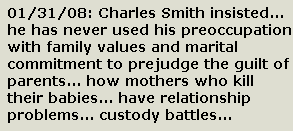 [ANONYMOUS LISTSERVE JOKE]:
"WORDS WOMEN USE... FINE This is the word women use to end an argument
when they feel they are right and you need to shut up. Never use "fine"
to describe how a woman looks - this will cause you to have one of those
arguments... [etc.] Send this to the men you know to warn them about
future arguments they can avoid if they remember the terminology!"
(The listserve moderator, a California doctorate-level MHP, January 8,
2004). [ANONYMOUS LISTSERVE JOKE]:
"WORDS WOMEN USE... FINE This is the word women use to end an argument
when they feel they are right and you need to shut up. Never use "fine"
to describe how a woman looks - this will cause you to have one of those
arguments... [etc.] Send this to the men you know to warn them about
future arguments they can avoid if they remember the terminology!"
(The listserve moderator, a California doctorate-level MHP, January 8,
2004).
[ANONYMOUS LISTSERVE JOKE]:
"I just got what I think is a very funny graphic file that is probably
too large to send to the list. So I am offering it back channel to
whomever requests it. Warning: this is sexist humor." (California
doctorate-level MHP, January 27, 2006).
[ANONYMOUS LISTSERVE
JOKE]: "Words women use FINE This is the word women use to end an
argument, when they are right and you need to shut up..." (Yes, a
redux, above, by the very same California doctorate-level MHP, February
11, 2007).
[ANONYMOUS LISTSERVE ENTHUSIAST]:
"Please note that in in the phrase: "OKAY, FINE!" the "Okay"
functions not as a repetition of agreement or assent, but as an intensifier,
signifying that you REALLY need to shut up..." (California lawyer,
February 11, 2007).
[ANONYMOUS LISTSERVE JOKE]:
"Blonde's Year in Review January Took new scarf back to store because
it was too tight... " (California doctorate-level MHP who is neither
cute nor blonde, March 21, 2007). (Appended after it was another blonde
woman joke and a redneck animal-sex joke.)
[Over
a period of six years, jokes (meaning ready-to-go internet matter, not
original witticisms) occasionally were posted to the anonymous listserve.
There were a small percent that were political jokes, a somewhat greater
percentage that were sexual-topic jokes, and in a few instances jokes on
other topics. The majority of jokes, however, were along the lines of those
above, with blonde jokes disproportionately represented.]
"The
great boob debate"
[ANONYMOUS LISTSERVE
PISSINGANDMOANING OVER BREASTFEEDING STUDY
UNDER THE SUBJECT LINE "The great boob debate]:
"....you know as well as I do that the phrasing will show up in
court, so I wanted the documents on all sides. thank you for your help
in getting them! I had trouble with my husband's medline... (California
doctorate-level MHP, January 30, 2008).
[ANONYMOUS LISTSERVE PISSINGANDMOANING
OVER BREASTFEEDING STUDY UNDER THE SUBJECT LINE
"The great boob debate]: "For all who asked, here is the
press release. Note the part about breastfeeding as long as desired by
mother and child, and sleep proximity. There is also an AAP
publication..." (same California doctorate-level MHP, January
30, 2008).
[ANONYMOUS LISTSERVE PISSINGANDMOANING
OVER BREASTFEEDING STUDY UNDER THE SUBJECT LINE
"The great boob debate]: "...if "professionals"
are relying on a press release, rather than the academic article that the
press release is based on, might we not be missing some importance nuances..."
(hopeful Texas doctorate-level MHP, January 30, 2008).
[The
subject line on these posts says it all. Breastfeeding, of course, is considered
by a number of evaluators to be tantamount to connived alienation and "gatekeeping"
to thwart their father-primacy infant overnight agendas. What apparently
flipped them out regarding a recent press release of research
was that it indicated that children of divorce fared better if they had
been breastfed. ("Researchers in Sweden and the United Kingdom
examined data on almost 9,000 children born in Britain in 1970. Relevant
information was collected at birth and again at ages 5 and 10 from parents,
teachers, health care workers and midwives. Teachers were asked to rate
the kids' anxiety levels on a zero-to-50 scale at age 10. And parents were
asked about major life events -- including divorce or separation -- that
occurred when their children were between 5 and 10 years old. Not surprisingly,
children whose parents had divorced or separated were more likely to
have high anxiety. But what the researchers found striking was the difference
in stress levels between breast-fed and bottle-fed kids. Breast-fed children
were significantly less anxious than kids who hadn't nursed at their mother's
breast...") In other threads in the past, a consensus of MHPs
just felt that the woman either could pump, a la a cow, or stood
on the unsupported "scientific" position that developing the
infant's relationship with the father was more beneficial than the health
of the mother and baby.]
LACK OF EXPERTISE
BY REASON OF PROFESSION
Lack
of Decision-making Ability
[ANONYMOUS
LISTSERVE COMMENT]: "I reviewed a case where the evaluator had all
sorts of methodological problems, testing errors, interpretation problems
and strong indications of confirmatory biases... the parents were already
doing a fair amount of exchanges with the kid... the evaluator criticized
the mother for this situation (part of the confirmatory bias, in my
opinion) and focused on how difficult it was for this kid to change so
frequently... the evaluator then recommended a custodial arrangement that
actually increased the number of exchanges... " (Florida doctorate-level
MHP, January 14, 2007).
[ANONYMOUS LISTSERVE COMMENT]:
"IMHO science and the methods of science are inappropriate for custody
determinations NOT because they will never achieve the predictive accuracy
of physics, but because science is an inappropriate method of determining/predicting/controlling
human values and behavior." (New York doctorate-level MHP, April 1,
2002).
[ANONYMOUS
LISTSERVE COMMENT]: "It's been my experience that most "experts"
don't have a freak'n clue about BR scores... the study by Bow et al. (2005)
made that pretty clear... I've heard "experts" testify that a
65BR was high on the MCMI-III because the mean is 50 and SD is 10... just
like the MMPI-2..." (Florida doctorate-level MHP who reviews MHPs,
February 12, 2007).
Lack
of Investigative Ability
[ANONYMOUS LISTSERVE COMMENT]:
"Your comments resemble those of O'Donohue & Bradley (1999)...
Their strong criticism of CCEs in general is based on the assertion of
inadequate theory and methods. They point out a weakness is the limited
time frame and the evaluator cannot follow a family over time and observe
events. I believe unless we are going to set up video cams in the two residences
we need to do our best to "clean up the data" which is
inherently full of bias and distortion... O'Donohue and Bradley proposed
a moratorium on all CCEs..." (Colorado doctorate-level MHP, January
12, 2003).
[ANONYMOUS LISTSERVE COMMENT]:
"hi all... a recent case of mine had me question the value of collateral
and collaterally derived information... I've become leary of police reports,
depositions, and interviews with collaterals, regardless of how neutral
they may present themselves... whatever happened to the days in which a
psychological evaluation included a clinical/psychosocial interview, some
well-chosen, well-standardized tests, and the clinician's integrative/clincial
skills... it seems that the more information invited, the more the evalaution
loses its credibility... I can begin to see why it is so comforting to
some to lose themselves in the microanalytic world of MMPI T-scores...
and yes, I realize that our jobs as evaluators is not to find the truth,
but to present scientifically grounded data, but I've begun to question
what that really means... may the gods forgive me" (Florida doctorate-level
MHP, January 25, 2004).
[ANONYMOUS LISTSERVE COMMENT]:
"It is very difficult to catch someone who is buying pills illicitly,
whether on the computer, on the street or through cash transactions with
certain MDs and pharmacies. There comes a point at which we as CCEs have
to give up the notion that we are investigators. Take what you do have
and write your reports based on the information you developed, the parenting
behaviors you have forensically defensible support for and use your training
and experience to come to some opinions. That is the best that any expert
can do, certainty does not exist in our field." (New York doctorate-level
MHP, February 22, 2007).
[ANONYMOUS LISTSERVE RESPONSE]: "As
I asked before, is there not a record on the computer used to get the medicaiton?
What could we conclude if there were cookies to several overseas pharmicutical supply
websites?" (Florida doctorate-level MHP, February 22, 2007).
[ANONYMOUS LISTSERVE RESPONSE]: "You
can't get access to the pharmacy's records without a subpoena...and you'd
have to do individual subpoenas for each individual location...and then
hope you hit paydirt...this is a data mining exercise..." (Florida
doctorate-level MHP, February 22, 2007).
[ANONYMOUS LISTSERVE RESPONSE]: "Data
on a PC are not ordinarily privileged (unless they happen to be communications
with therapists, lawyers, etc.). Without a privilege, they are subject
to ordinary discovery if examining the data is likely to lead to relevant
evidence. There is a general Constitutional right to privacy under prior
interpretations of the 14th Amendment, but the threshold for overcoming
it in legal discovery is ordinarily set very low..." (Michigan doctorate-level
MHP, February 22, 2007).
[Wait-a-sec
here... where did MHPs get trained as government-hired investigators of
litigants' computer contents, or elevated into arbiters of litigants' constitutional
rights... Do they even know what they are looking at or where to look on
someone's computer? Are they deemed to be computer experts too? Do the
results they obtain constitute "facts or data of a type reasonably
relied upon by experts in the subject to support the opinion
expressed"? Also see Role Confusion,
Lack of Appreciation for Due Process,
and Arrogance.]
Lack
of Judgment
[ANONYMOUS
LISTSERVE COMMENT]: "Parents don't get anywhere near my office until
the order is signed. Once it is signed, any observation -- whether in the
parking lot, the waiting room, wherever -- is grist for the mill. If I
got an order to evaluate a family and remembered seeing one of the parents
do something inappropriate in the parking lot, I might consider declining
the case due to having pre-evaluation information that could influence
my judgment. The key issue is whether the evaluator had been appointed
yet -- not where the observation took place. (California doctorate-level
MHP, July 4, 2005).
[ANONYMOUS LISTSERVE RESPONSE]: "I
guess all would agree that an observation of a party anywhere would be
a problem if it occured before a court order for an evaluation had been
completed. A second issue that could come up is inadvertent observations
in the community, post-order. My only point here is that it is wise to
have a statement in the order stating that the evaluator can evaluate any
and all observattions during the evaluation period. That way nobody could
say you were biased by idly sitting in your car at the supermarket watching
Dad with the kids and did not to the same for Mom." (another California
doctorate-level MHP, July 4, 2005)
[Would
it taint a physician's investigation of the cause of a claimant's disability
to have been an eye-witness observer to the car accident subject of the
lawsuit? Is a custody evaluation some kind of game in which ground rules
dictate that only out-of-court observations made while the investigator
is "on the clock" fairly can be used? Apparently so...]
[ANONYMOUS LISTSERVE QUESTION]:
"...the parties are in separate residences. Obviously the bulk of
the young (under 6) child(ren)'s toys (video games, trains, dolls, books)
are on the shelves/in the room of the child(ren) in the marital residence.
The currently displaced parent (quite capable of purchasing a second
set of... name the object) insists that the currently residential parent
send over half of whatever ("After all they are Janie's/Johnny's
toys not ours... (and) "How could you be so selfish and deny...")"
(Florida doctorate-level MHP, March 1, 2007).
[ANONYMOUS LISTSERVE RESPONSE]: "In
doing family therapy, I sometimes use the approach that children in
our state do not "own" personal property. Parents may
"give" something to a child, but ownership is retained by the
parent. This eliminates back talk such as "You can't take that
away from me" or "Why do I have to share it, it is mine!"
Perhaps a logical extension of this would be for parents to consider
items such as toys and clothes to belong to each parent and not the child
to be taken freely between homes..." (Oklahoma doctorate-level MHP,
March 1, 2007).
[ANONYMOUS LISTSERVE RESPONSE]: "Regarding
making the children's clothes the property of the parent. Up to what
age? Put yourself in the shoes of the 10 year old..." (California
lawyer, March 1, 2007).
[ANONYMOUS LISTSERVE RESPONSE]: "If
there are disciplinary/behavioral/academic problems, well, the the
Play Station, the X-box, etc. become ways, hopefully, to teach children
the concept of needs vs. wants, and that the luxuries of life may be withdrawn
(and must be earned back) when age-appropriate behavioral expectations
are not met, including HW, chores, respect, compliance, etc... however...
There are items that I believe the children have the right to view as their
own... I typically recommend to divorced parents that they purchase
duplicates of whatever they can to limit the chaos caused by 'forgotten'
items (and to reside as close as possible to each other for the occasions
of forgotten items that cannot be duplicated)..." (California
doctorate-level MHP, March 1, 2007).
Lack
of Expert Credentials in a Relevant Area of Inquiry (but sometimes opining
anyway)
Pharmacology,
Toxicology, and Substance Abuse; Effects on Parenting
[ANONYMOUS LISTSERVE COMMENT]:
"Toxicology results can only reliably tell us about the presence or
absence of a particular substance at detection levels. Drawing levels on
substances that metabolize in a day or two, like opiates, is not particularly
meaningful. However, taking these substances has effects other than reducing
the experience of pain. It also effects the dopamine system which is heavily
implicated in prefrontal lobe or executive functions such as judgement
which encompasses parenting." (New York doctorate-level MHP who is
not a physician, pharmacologist, or toxicologist, February 20, 2007).
[ANONYMOUS LISTSERVE QUESTION]: "So,
given that exec functions are possibly negatively impacted, how would you
suggest that a CCE investigate/test/assess pre-post to determine the parenting
implications? I have had several cases like this and have spoken to
the MD's/DO's who have verified what you and others have said previously...
so even if used appropriately there can still be a significant impact...
so what do we do?" (Texas doctorate-level MHP, February 20, 2007).
[ANONYMOUS LISTSERVE QUESTION]: "...how
do I demonstrate to the court that one parent is abusing theri pain medication,
when her aggressive attorney is staunchly claiming she is not? she
has a back problem and is on disability for it. I have observed
her to be chemically altered... however without scientific proof (drug
test) her attorney has aggressively argued that she is NOT impaired..She
is sleep-deprived because of her 'abusive' husband....Her doctor who prescribed
one medication is on record saying the woman has been "completely
honest"..." (Illinois doctorate-level MHP, February 20, 2007).
[ANONYMOUS LISTSERVE RESPONSE]: "
The issue isn't whether she's taking the meds... she admits to that.
The issue is whether her parenting is impaired by the medication.
I'd be interested in what the altnerative explanation is for the multiple
doctors and pharmacies, other than the obvious one, but the more important
issue is whether her parenting is impaired. If you, teachers, and
others have observed her to be "chemically altered," what does
that mean and how does it manifest in terms of parenting?" (California
doctorate-level MHP, February 20, 2007).
[What
psychology is involved here? Isn't this ordinary eye witness evidence?
How much observation would the MHP eye witness actually have of "parenting
while under the influence"? Or does the MHP just "assume"
impairment? Or incorporate as a basis for "expert" opining the
hearsay claims of... the opposing party? or teachers who have even less
eye witness observation of "parenting" let alone a basis to assume
chemical influence? The reality is that the MHP in fact has no facts, but
has decided that " exec functions are possibly negatively impacted"
by prescription drug-taking that she cannot prove is even taking place
let alone impairing parenting, and so is grasping about for evidence with
which to, essentially, assist the father's case with evidence and argument,
and then opine in the manner of any ordinary trier of fact having weighed
that evidence and argument. Compare these MHP ponderings with the MHP requirement
of proof of parenting impairment when it's male sexual behavior, supra.
But lest you think it's an arguably justified bias that sex perversion
doesn't affect parenting abilities, behaviors, and attitudes at other times,
whereas chemical abuse can be presumed to do so, check out the discussion,
below, about a proved 4-time criminally-convicted alcohol abusing father:]
[ANONYMOUS LISTSERVE QUERY]:
"Does anyone have anything concrete on parenting/alcohol problems?
Like the porn as a deal breaker thread, I have a parent that although
he/she has four DUI's (over the course of twenty years) says that they
are not alcoholic, and I am looking for research on something tangible
here. No elevations on a valid MMPI-2. Nothing, Nada, Kaput..." (California
doctorate-level MHP, August 30, 2005).
[ANONYMOUS LISTSERVE RESPONSE]: "...we
haven't necessary established that this parent can be described as a "substance
abuser" under DSM criteria." (California doctorate-level MHP,
August 20, 2005).
[ANONYMOUS LISTSERVE RESPONSE]: "First
things first. First evaluate or have the person evaluated in regard to
have a substance abuse or dependence problem. Then related the behavioral
correlated to the persons capacity to parent effectively. This number of
DUIs in and of themselves might be considered enough of an impairment..
the reason for DUI is less important then the DUI.. The issue of not drinking
in front of the children.. There are many behavioral correlated of etoh
and other drug abuse that impact kids.. They are exposed to hang overs
for example." (Florida doctorate-level MHP, August 31, 2005).
[ANONYMOUS LISTSERVE RESPONSE]: "I
disagree that the reasons for the DUI are less important than the DUI.
Both are important. Are we talking 4 DUI's in 20 years, with 3 having occurred
in the last 6 months, or are they spaced differently? What are the intervening
variables, and what makes this parenta slow learner?" (California
doctorate-level MHP, August 31, 2005).
[ANONYMOUS LISTSERVE RESPONSE]: "...we
need more information...there's a big difference between someone who
has an occasional drinking behavior and gets pulled over because of underestimating
impairment and someone who's drinking behavior is problematic in other
areas as well..." (Florida doctorate-level MHP, August 31, 2005).
[ANONYMOUS LISTSERVE RESPONSE]: "One
can't help but wonder about the learning curve on this guy. Didn't
he notice what a pain in the neck it is going to all those AA meetings
just to get his drivers license back? Twenty years! That means he had to
start real early and go into his 40's with this behavior. Interesting to
know if each DUI was linked to traumas or if his "life long"
best buddies have red faces and rather large stomachs. On the other hand,
I had a case where a recovering drug dealer/addict (after five years
of treatment) turned out to be one of the best parents I've met."
(California doctorate-level MHP, August 31, 2005).
[A
fluke? More below...]
[ANONYMOUS LISTSERVE COMMENT]:
"As an evaluator, I'm not particularly worried about a single DUI...
particularly if it was a while ago...now, get 17 and then I'm thinking
that's a problem... Let's think about who gets a DUI...first, you need
someone who comes into contact with law enforcement, like being pulled
over or when they're in an accident... most folks with chronic alcohol
problems don't have difficulties driving while drunk... I've spent enough
time in the ER during my training and earlier years in practice to know
that it's not unusual to find folks with BAL's of 0.35 and up...and they're
pretty damn functional... it's folks who don't have enough practice at
being drunk and driving that get nailed...or...people like the ones on
this list who go to a party, have three or four drinks and then drive..."
(Florida doctorate-level MHP, April 3, 2005).
[ANONYMOUS LISTSERVE COMMENT]:
"...the mother is denying her use of alcohol, (as well as her overuse
of prescribed meds) so if I ask her psychiatrist if he has any information
about her drinking, he would ask her, she would deny it and he has blindly
accepted what she reports..." (Illinois doctorate-level MHP, September
11, 2006).
[ANONYMOUS LISTSERVE COMMENT]:
"Clearly, the Mom's Bipolar II and Alcohol issue impacted her parenting...but
that's only my opinion..." (Florida doctorate-level MHP, February
9, 2007).
Lack
of psychometric test administration skill:
[ANONYMOUS LISTSERVE COMMENT]:
"I have been in a number of matters where allied mhp's, licensed and
experienced in their respective fields, had administered MMPI's and badly
misinterpreted the results contributing to a flawed and problematic opinion.
They routinely used the MMPI and other technical psychological tests and
had significant forensic practices..." (Tennessee doctorate-level
MHP, March 26, 2007).
Lack
of Methodology
[ANONYMOUS
LISTSERVE COMMENT]: "I only see the kid with each parent. I think
setting up a session with the kid over whom they are fighting has the potential
for doing great harm to said kid." (California doctorate-level
MHP, July 6, 2005).
[ANONYMOUS LISTSERVE RESPONSE]: "Great
harm compared to what? If the parents on their very best behavior cannot
be in the same room as the child without dire consequences, how are they
going to do pickups and dropoffs, joint attendance at school recitals and
open houses, meeting at the kids' Little League games, etc.?" (Michigan
doctorate-level MHP, July 6, 2005)
[ANONYMOUS LISTSERVE COMMENT]:
"It raises an interesting issue for folks who send home questionnaires...
you send home __'s 40 pager, and the parent is supposed to fill it out...
supposed to..in the case of a pro se litigant -- and when that parent's
a lawyer -- the parent and attorney are completing the questionnaire...
same with the testing taken at the office... So far, I've never seen
any caveats in a report by those who send home such questionnaires... caveats
about not knowing who filled out the information, and the possible threats
to reliability/validity of the data...interesting... but I do hear folks
say "it's just another piece of data"... I love that... somehow,
that makes it ok to do and not comment about the limitations of the data..."
(Florida doctorate-level MHP who specializes in psychometric testing, August
11, 2006).
[NONSOANONYMOUS LISTSERVE]:
"...my point would have been better said had I clarified that personality
test "data" are to be used "by psychologists" for hypothesis
generation as opposed to hypothesis testing." (Colorado doctorate-level
MHP, February 20, 2007).
[NONSOANONYMOUS LISTSERVE RESPONSE]: "I
don't agree with this. I think tests are used to generate data, not hypotheses.
Psychologists are used to generate hypotheses." (Colorado doctorate-level
MHP, February 20, 2007).
Just
Not All That Swift
[ANONYMOUS
LISTSERVE QUESTION]: "What can anyone tell me about any research
in this area for non-white populations (in this case, native Canadian male)?
What, if anything, can we say about elevated or non-elevated (normal) scores?
In the case at hand, I have a very high L (92) , with R (67), Mp (76),
K (70) and S (74), along with clinical scales all hovering around 50."
(Canadian doctorate-level MHP, April 3, 2007).
[ANONYMOUS LISTSERVE REPLY]: "With
an L of 92, I would retest her. Following suggestion in the manual
and texts (e.g., Greene), tell the client to be more open and honest. L
is associated with IM, something that is likely under her control."
(North Carolina doctorate-level MHP, April 4, 2007).
[On
the anonymous listserve, misreading and faulty fact recall was so frequent
as to be especially notable, even without considering that the participants
for the most part were highly articulate, doctorate-level individuals (and
authors) professing to have expertise in investigating, weighing, and assessing
evidence, and giving practice advice to their peers who were handling serious
matters. The repeated mistakes and inability to grasp and remember the
facts in a post being directly replied to, as in the example above, which
even quoted the query post, were alarming. It occured even more often as
to facts contained in more remote queries which commenced discussion threads,
and still more often in the failure to make correct inferences flowing
from given facts. Custody litigants sometimes ramble. Their cases can be
complex, and the facts -- collected by MHPs in many stops and starts over
many months, unlike evidence presented at most trials -- can be unclear
under the best of circumstances. Add into the mixture various evaluator
biases, and it's a recipe designed to regularly serve up disastrously wrong
opinions.]
LACK OF SUBJECT MATTER EXPERTISE
[NOTSOANONYMOUS
LISTSERVE QUESTION]: "Folks, Here is a 2 part question: 1. Is there any good empirical literature on the co-occurance of domestic
violence against a spouse and child physical abuse? 2. If you were assessing a family where the father had a history of DV
there was a divorce and he wanted unsupervised visitation, how would you go about assessing risk?" (New Hampshire doctorate-level MHP ABPP (Forensic), July 22, 2009).
[NOTSOANONYMOUS
LISTSERVE LONE RESPONSE, NEXT DAY]: "
[], here is a start. my assessment frame would be a standard risk assessment for child abuse." (New Jersey doctorate-level MHP, July 23, 2009).
Group
Think
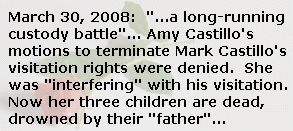 [ANONYMOUS LISTSERVE REQUEST]:
"I would very much appreciate it if any of you would forward on to
me any strong references (including studies) about custody plans per age
and stage of development of the child." (Louisiana masters-level MHP,
June 15, 2001). [ANONYMOUS LISTSERVE REQUEST]:
"I would very much appreciate it if any of you would forward on to
me any strong references (including studies) about custody plans per age
and stage of development of the child." (Louisiana masters-level MHP,
June 15, 2001).
[ANONYMOUS LISTSERVE RESPONSE]: "Funny
you should bring this up! Joan
Kelly is putting a one-day presentation on 6/27 titled "Devloping
Effctive Parenting Plans Using Child Devlopment & Divorc Research"
here in the S.F. Bay Area..." (California doctorate-level MHP, June
15, 2001).
[ANONYMOUS LISTSERVE COMMENT]:
"Joan Kelly, PhD will be doing a half-day training in Santa Fe, NM
titled, "Using Child Development Research to Develop Age-Appropriate
Custody and Visiting Arrangements," Friday, February 28..." (New
Mexico doctorate-level MHP, January 20, 2003).
[ANONYMOUS LISTSERVE MODERATOR]:
"___'s reading of my post was correct. I have no intention of booting
him (or anyone else) who's qualified off the list. I know other people
-- ___, ___, the infamous Liz -- have agendas for being provocateurs; I
just didn't understand why ___, being 'one of us', would want to be on
the list in the same role. But if he does, so be it. I imagine we each
have our idosyncratic preferences..." (List moderator, doctorate-level
MHP, June 9, 2001, who five years later, long after two of the three persons
mentioned were gone, suspended Liz from list participation unless and until
she assented to the notion that everyone on the listserve was there for
the purpose of doing well by children and stopped making "personal
attacks", i.e. pointing out when various posters' words or stated
acts appeared to be lacking in veracity, logic, competence, neutrality,
fairness and/or appropriate motives.)
[ANONYMOUS LISTSERVE COMMENT]:
"In the past, I've asked the list for references to cite in appellate
briefs (most of which get posted by West on the internet when the decision
is issued). I have summarized the facts of the case that relate to the
issue at hand, and then asked for research to cite to the Court of Appeal."
(California lawyer, August 11, 2006).
[ANONYMOUS LISTSERVE COMMENT]:
"...when I evaluate a family with children younger than 10 or so,
I retain (and pass on the cost of) a child psychologist. While I know a
great deal about child development, the affect of divorce on children,
etc., I am not a child psychologist, and the evaluation is too important
to take a chance that I might miss something significant." (Wisconsin
doctorate-level MHP, February 11, 2007). [He said WHAAAAT?]
[NOTSOANONYMOUS LISTSERVE QUESTION]:
"...question. I completed a presurgical psychological evaluation prior
to gastric bypass surgery the other day. The client presented as a woman
but is actually a man that is looking into sex reassignment surgery a year
or so down the road...When plotting the MMPI do I use male or female graph?
Same question regarding male/female norms on the other tests..." (Doctorate-level
MHP, February 14, 2007).
Not
the Parenting Mavins You Might Think
[ANONYMOUS
LISTSERVE REQUEST]: "My apologies if this has been recently covered,
but I am looking for some cites on how a parent's depression (long-term
major) effects the children. I searched the archives and came up empty
- except for a post from ___ saying that there is research on depression
and parenting." (Louisiana masters-level MHP, June 13, 2001).
[ANONYMOUS LISTSERVE RESPONSE]: "I
think this is addressed in my book." (North Carolina doctorate-level
MHP, June 14, 2001).
[Who
actually wrote his book?]
[ANONYMOUS LISTSERVE REQUEST]:
"I received an inquiry from an attorney requesting information pertaining
to what defines "stability" for a five-year-old... Any thoughts,
references to share?" (Illinois doctorate-level MHP, June 13, 2001).
[ANONYMOUS LISTSERVE RESPONSE]: "Kelly,
J.B. and Lamb, M.E. (2000). Using child development research to make appropriate
custody and access decisions for young children. Family and Conciliation
Courts Review..." (California doctorate-level MHP. June 13, 2001).
Over
a period of nearly six years, the above responder and others cited generally
and repeatedly, often by just referencing the name, to mostly the same
small club of prolific authors of custody sophistry, including Kelly, Lamb,
Braver, Warshak et al., and even themselves, rarely discriminating between
"think pieces" and other editorial matter not grounded in research,
and research findings, on a wide variety of issues. During one period of
24 months, there were 115 posts containing or quoting references to both
Kelly and Lamb. The problems with this incestuous group of cross-pollinating
and cross-referencing literature are discussed in articles that can be
found at the top of http://www.thelizlibrary.org/liz/,
and most recently in Prof. Carol Bruch's article
on the subject). On repeated occasions when the editor of this webpage
pointed out both general and specific examples of this problem, the responder
stupidly demanded to know whether this author had published any of her
critiques in "peer-reviewed journals" like "we do"
rather than on in advocacy "polemics" and webpages. Does an individual
who points out that a belief in the gods of Mount Olympus has no basis
in reality really have to publish that observation in a peer-reviewed theological
journal to give it credibility? Did the little boy who noted that "the
Emperor has no clothes" really have to demonstrate that by spinning
and sewing a new set for his highness and comparing it to the nonexistent
attire stitch by stitch? See Lack of
Judgment, supra, and Arrogance,
infra.)
[ANONYMOUS LISTSERVE COMMENT]:
"A basic tenet in law is that the burden falls upon the proponent
of a technique to document its reliability; the burden is not upon the
skeptic to document lack of reliability or validity." (New Jersey
doctorate-level MHP, February 21, 2007).
[ANONYMOUS LISTSERVE QUERY]:
"I have some parents who are blaming each other for their children's
bad behavior. The kids are boys 7.8 and 10.6 years. The kids are cute enough,
not funny looking, normally intelligent, and do not show any symptoms of
major mental illness. Teacher ratings describe them as too aggressive and
under socialized. They have been living mostly with mom... Mom's home is
disorganized... Dad's home is tiny, cluttered, unclean, smells bad... On
the usual tests where the kids could show some impulsiveness that would
hurt their success, they showed only a little impulsiveness (E.g., answering
before the question was finished). They show no in-office symptoms of hyperactivity
or other impulsive disorders. When I gave the softest reprimand I could
for them violating a social-personal boundary, the child was upset and
was still a little ashamed a week later (Thus suggesting that they are
responsive to direction and criticism). This one was still violating personal
boundaries a week later too. I think they might be simply under socialized.
They may never have had an adult consistently teach them civil behavior.
How do I measure their degree of socialization and compare it to "normal"
developmental curves..." (Texas doctorate-level MHP, June 14,
2001).
[ANONYMOUS LISTSERVE QUERY]:
"Does anyone know about the number of sessions for effectively treating
children? I seem to remember 8 to 10 sessions for maximizing results; then
their progress diminishes as well." (Virginia doctorate-level MHP,
June 14, 2001).
[ANONYMOUS LISTSERVE COMMENT]:
"No amount of money can predict the inherently unpredictable. We've
only just begun. What little knowledge we have is primitive. I sometimes
imagine the body of knowledge psychologists now hold is comparable to the
body of knowledge held by physicians in, say,the sixteenth century. (New
York doctorate-level MHP, April 1, 2002).
[ANONYMOUS LISTSERVE COMMENT]: "...psychologists,
until recently, have too often been self-satisfied and sometimes self-aggrandizing.
They have been too reluctant to admit that the knowledge base and research
methods upon which they have traditionally based their opinions were inadequate,
and sometimes pseudoscientific, superstitious or quasi-religious."
(California doctorate-level MHP, April 1, 2002.)
[ANONYMOUS LISTSERVE QUERY]:
"I know we have been over this, but in the context of a CCE how does
one describe the scientific basis of the importance of siblings..."
(Colorado doctorate-level MHP, December 26, 2003).
[ANONYMOUS
LISTSERVE QUERY]: "I could use some input here... mom... and
her significant other are planning a quick wedding because she is pregnant...
She and now husband-to-be (a professor at a Catholic university) are coming
in to meet with me to talk about ways to approach this with the two kids..."
(Doctorate-level MHP, January 14, 2004).
[ANONYMOUS LISTSERVE REQUEST]:
"Can anyone provide me with a recent article that addresses the effects
of co-habitation (as opposed to marriage) on children? Or impact of step-siblings
on children?" (Illinois doctorate-level MHP, February 27, 2005).
[ANONYMOUS LISTSERVE REQUEST]:
"I will be starting an internat'l move away CCE. Parent has moved
to country that is in the Hague Con. Are there any issues that need to
be addressed that would be differnt than a local move away? Provisions
that need to be considered in the recommendations? I've already thought
about time distance and cost of visitation." (California doctorate-level
MHP, February 27, 2005).
[ANONYMOUS LISTSERVE RESPONSE]: "cultural
issues and values... attitudes toward woman; religious freedom; access
to educational opportunities..." (Florida doctorate-level MHP, February
27, 2005).
Not
the Research Mavins You Might Think
[ANONYMOUS
LISTSERVE REQUEST re two readily-available law review articles]: "Can
anyone come up with either of these article for me, or tell me where I
might be able to download them?" (California doctorate-level MHP,
December 26, 2005).
[ANONYMOUS LISTSERVE REQUEST]:
"Can you find this article?" (Georgia doctorate-level MHP, January
14, 2007).
[The
article in question, The Family Journal -- a Sage publication -- Vol. 8,
No. 3, 309-316 (2000), "An Interview with Robert Marvin: Linking Systems
and Attachment Theory" was located on the internet the same day in
exactly 14 seconds by this author at http://tfj.sagepub.com/cgi/reprint/8/3/309
.]
[ANONYMOUS LISTSERVE
REQUEST]: "Under what circumstances, if any, is it possible for minors
to seek psychological treatment in confidence, without the knowledge or
consent of their parents? And what about access to medical/records without
parental consent?" (New York doctorate-level MHP, January 27, 2007).
[ANONYMOUS LISTSERVE REPLY]: "Um,
that would be your state's laws/regulations governing treatment and record
keeping.... Not to sound rude or unkind, but isn't this something that
we all (should) get taught in grad school - I mean it's basic consent to
treat kind of stuff..." (Texas doctorate-level MHP, January 28, 2007).
LACK
OF SCIENCE
Clinical Experience -- learning from Hollywood fiction
[NOTSOANONYMOUS
LISTSERVE COMMENT]: "I really think a great study in all this is the movie "Goodwill Hunting." There you see the mixture of everything you're talking about here, J--,
with a client who didn't initially show an initiative or a desire to change
and in fact was openly resisting it. The therapist in the movie, at different times and as called for by what
was going on with the client, showed exactly the combination of warmth,
genuineness, compassion, empathy, and confrontation (and yes, even at times
hostile confrontation) you're talking about here. There wasn't an overreliance on any one of these therepeutic strategies,
but rather a flexible use of them based on what what was going on in the
relationship and what, at any particular moment, would be therapeutic. (Doctorate-level MHP, October 28, 2009).
Directionless
Curiosity aka Fishing
[ANONYMOUS
LISTSERVE COMMENT]: "I'm wondering why [some of you think] it's
not helpful to observe parents teach children to fish... I've found
it very interesting to see what parents come up with when given the albeit
overly general directions to "bring something to teach your child.'
Whether or not the "something" is age appropriate, something
the kid is interested in (or not), how patient the parent is when the kid
really screws something (like dad's brand new camera) up, or even how it
made me tear up a little when a dad taught his two adolescent sons how
to tie a necktie... I think it's been very insightful... not the holy grail,
but what is???" (California doctorate-level MHP, July 6, 2005)
[ANONYMOUS LISTSERVE RESPONSE]: "My
favorite was when the dad and 6 y.o. son played checkers -- at dad's
insistence -- and dad cheated obviously -- put pieces down on different
squares than they had been) to beat the little bugger handily. Even when
Jr. was trying not to cry, dad was gloating, snickering and telling kid
what a loser he was. What inferences might we safely draw?" (Lousiana
masters-level MHP, July 6, 2005)
[ANONYMOUS LISTSERVE RESPONSE]: "I've
seen some bizarre things in observation sessions too... and occasionally
I've seen some outstanding parenting, even where the parent was taking
what he or she might have perceived to be a risk (setting limits, etc.).
I'd never go without them because occasionally the observations are quite
significant and backed up by other data -- or lead to hypotheses which
can then be explored with other data." (California doctorate-level
MHP, July 6, 2005)
[ANONYMOUS
LISTSERVE RESPONSE]: "I like the idea of having the parent choose
the teaching task & agree with ___ that this could be a fruitful
area of exploration. One thing I've done is to buy one of those kids'
workbooks they sell in all kinds of stores that provide worksheets on (e.g.)
math & English concepts... I chose one that's one grade beyond where
the child is presently, in order to 1) make sure it's not something they've
already studied and 2) that the parent have to actually try and teach something
and 3) observe how both deal with the likely frustration that comes with
learning something new. I have to be sure I'm not selecting something that's
developmentally inappropriate (like abstract thinking to a 10 year old)
but otherwise, I don't place any limits on what I use. This can sometimes
be a revealing process! (California doctorate-level MHP, July 6, 2005)
[The
above could also have been listed under a "bias" category. It's
skewed toward the more highly educated (and English-speaking) parent, and
is not necessarily reflective of what -- or how -- parents teach children.
The listserve participants unanimously rejected this author's suggestion
that the MHPs just take the parent and children to a restaurant near their
office, ostensibly as a break from the evaluation, and observe them doing
something from real-life, with far less contrived behavior, more likelihood
of spontaneous conversation, opportunity to observe the children's behavior,
and potential for insight into each parent's manners-teaching and nutritional
choices. The author's impression from the numerous negative comments received
was that this was a scenario that either wasn't within most of the MHPs'
own social or parenting skills, or else would too clearly show the primary
caregivers as being the far more competent parent.]
[ANONYMOUS LISTSERVE COMMENT]:
"I think that, just as with any other test procedure, the MCMI-III
can be used as a cross-validation technique to assess pathology or the lack
thereof. On the outside chance that a parent would produce a valid
profile (which I have actually seen happen on rare occasions), the MCMI-III
could provide interesting personological information. Just because
a parent is not in treatment does not mean s/he shouldn't be." (California
doctorate-level MHP, February 11, 2007).
[PEARSON TEST PUBLISHER'S WEBSITE]:
"When is it appropriate to use the MCMI-III test? The MCMI-III test
should be used for diagnostic screening or clinical assessment of adults
who evidence problematic emotional and interpersonal symptoms or who are
undergoing professional psychotherapy or a psychodiagnostic evaluation.
It should not be used with nonclinical cases." (February 11,
2007, http://www.pearsonassessments.com/tests/mcmi_3.htm "Questions
and Answers").
It's
Just Not Science
 [ANONYMOUS LISTSERVE COMMENT]:
"The precursors of social scientists began to imitate the methods
of physics and the sciences around the late 1700s (see A. Compte, for instance).
The hope of social scientists then (at first they were called "Moral
Philosophers," and were not called "scientists" until the
1800s, when the word "scientist" was coined) and now was that
by imitating the "hard" science, eventually social science
will achieve the success of, say, phyics or biology. I believe that goal
is an unachievable illusion. I believe the subject matter of study of the
"hard" sciences and the social sciences are so fundamentally
different that the same methods cannot achieve the same level of success
in both." (New York doctorate-level MHP, April 1, 2002). [ANONYMOUS LISTSERVE COMMENT]:
"The precursors of social scientists began to imitate the methods
of physics and the sciences around the late 1700s (see A. Compte, for instance).
The hope of social scientists then (at first they were called "Moral
Philosophers," and were not called "scientists" until the
1800s, when the word "scientist" was coined) and now was that
by imitating the "hard" science, eventually social science
will achieve the success of, say, phyics or biology. I believe that goal
is an unachievable illusion. I believe the subject matter of study of the
"hard" sciences and the social sciences are so fundamentally
different that the same methods cannot achieve the same level of success
in both." (New York doctorate-level MHP, April 1, 2002).
[ANONYMOUS LISTSERVE COMMENT]:
"One issue was overnights for a 21 month old boy. Mother was strongly
opposed. Father alleged a long pattern of mother making contact difficult
and transitions were being sabotagued by her. Mother said the boy did not
want to go with father. The judge I believe was impressed by my description
of the transition at my office. Mother had dropped child for the father-son
observation session. When she came to pick him up she entered the office
reception area without saying a word, angry look on face, and literally
snatched the child from father's arms and left. Case is over. Father gets
overnights and a graduated increase to overnights and weekends to the goal
of equal parenting time when Kindergarten starts." (Colorado doctorate-level
MHP, January 23, 2003).
[The
parties here apparently paid for, and the case was decided on, what was
plain old lay witness fact testimony. And it is not surprising that the
court found it impressive. This sort of "investigative methodology"
and "cleaning up of the data" (see Lack
of Investigative Ability, supra) is the subject of custody
evaluation how-to literature written by the same MHP. Of course, because
it was a verbally articulate "expert" testifying, high credibility
was given to the subjective perceptions that Mother had an "angry
look" on her face and that what had transpired was that she "snatched
the child from the father's arms".]
It's
Not Science -- But That's Okay if I Like It
[ANONYMOUS
LISTSERVE COMMENT]: "What I like about Kelly & Johnston's framework
is that it casts alienation as a behavioral state in the child (the state
of rejecting a parent), not in a parent, that is the multidimensional outcome
of a variety of influences..." (New York doctorate-level MHP, August
9, 2006).
[ANONYMOUS LISTSERVE COMMENT]: "Conceptually,
isn't Alienation intended to describe a process which occurs in a postdivorce/separation
environment and can involve either/both parents and can be further be fueled
by the child (e.g., child driven alienation such as discussed in Warshak's-Divorce
Poison book.)? I do agree that Johnston and Kelly's article is 'the'
article to utilize when testifying and/or attempting to describe the
issue in one's report. Sadly "Alienation" now seems to the allegation
to throw out by a parent when petitioning for custody as if somehow by
mentioning it, it empowers the holder of this statement." (Oklahoma
doctorate-level MHP, August 9, 2006).
[ANONYMOUS LISTSERVE COMMENT]:
"I have written quite a bit about restraint and intrusiveness. Nonetheless,
there is a body of experience and expertise of what works.,," (California
lawyer, June 9, 2001).
[ANONYMOUS LISTSERVE RESPONSE]: "If,
by 'body of knowledge' you mean social science literature/research about
families, I would also disagree with you. We have cultural values, we have
personal preferences and we have some 'science' based on accidental, questionably-representative
samples. We also have academies that, at this moment in history, are powerfully
biased in a certain direction. Also, every day during the last five minutes
of the evening news we have yet another social science study that claims
that whatever you used to think is not true, it's really this other way."
(New York doctorate-level MHP, June 9, 2001).
[ANONYMOUS LISTSERVE COMMENT[:
"First you expand the garbage so that it takes up more room. More
is better. Then you package it with attractive words, preferably BIG attractive
words, because then it is hard to know that there is garbage inside and
the insulation retards rotting. Then, you give it to the recipients with
a gigantic flourish, sometimes spraying O de toilet on the package to add
a pleasant odor. Then you say, 'Oh, Your Excellencies and Your Eminences,
this was one of the most difficult and complex evaluations I have performed
in my 105 years of doing such evaluations. But, I have found the primal
causes for the conflicts and my opinions may provide lasting peace for
the positive growth and development of the little ones.' You then hand
over the report. When questioned about the MMPI-2 results you invoke the
five Gods of MMPI-2 CEU profiles and say, 'It is clear your Highnesses
that these profiles are typical of those obtained from persons who are
evaluated in the course of a highly conflicted custody battle. Such
people are known to respond to the situation by becoming highly overwrought.
I have removed the overwroughtness from my interpretation of their MMPI-2s,
which is shown in their elevated L, K and S scales, and I have given you
the essence of who they are under more usually circumstances. That is to
say, were they not involved in this dispute with one another over custody
of their children they would be the calm, empathic, attuned parents and
citizens of the world that they usually are.' " (California doctorate-level
MHP, April 10, 2007).
[NOTSOANONYMOUS LISTSERVE REQUEST]:
" Hi Gang, I need a citation for the fact that insight can follow
behavior change. I know that cognitive therapy and other forms of behavioral
intervention are built on that, but if you were going to cite the idea,
where would you credit it? Thanks much" (California doctorate-level
MHP, December 20, 2008).
Protecting
Vested Interests (Work in the Court System)
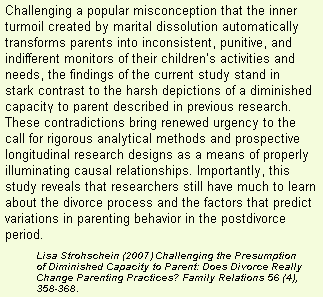 [ANONYMOUS LISTSERVE COMMENT
from listserve administrator]: "I have a 3 page pdf titled "Custody
Disputed" by Randy Otto & 2 other people I've never heard of (Robert
E. Emery & William O'Donohue) that is a scathing indictment on the
lack of scientific rigor in CCEs. If you want it, send me a back channel
email." (California doctorate-level MHP, October 1, 2005). [ANONYMOUS LISTSERVE COMMENT
from listserve administrator]: "I have a 3 page pdf titled "Custody
Disputed" by Randy Otto & 2 other people I've never heard of (Robert
E. Emery & William O'Donohue) that is a scathing indictment on the
lack of scientific rigor in CCEs. If you want it, send me a back channel
email." (California doctorate-level MHP, October 1, 2005).
[ANONYMOUS LISTSERVE RESPONSE]: "I
read this article the other day and found it simplistic and naive. There
is a bolded out print header saying that parents should cooperate and make
their own decisions about their children. Give me a break. The cry for
better science could be said about almost any court related expert topic."
(California doctorate-level MHP, October 1, 2005).
[ANONYMOUS LISTSERVE RESPONSE]: "What
parts specifically did you find "naive"? I think the "simplistic,"
sweeping statements are likely a function of the article's appearing in
the "lay press;" even so, it sounds as though he is referring
to specific bodies or research and specific issues regarding custody evals.
(eg., use of custody-specific "tests" al a Ackerman & Bricklin)
that have been a frequent focus of this list. I must say that I agree that--absent
abuse or allegations thereof, and absent concerns of problems with the
children or parent(s) that require special expertise to evaluate, the involvement
of families in the adversarial system serves only to increase the level
of conflict between the parents and increase the stress on the kids. Cooperative/collaborative
law approaches to family law have been used successfully in a number of
jurisdictions--mental health professionals are often involved early on,
but the prototypical CCE is considered to be a last resort---for good reason,
IMHO." (Doctorate-level MHP, October 3, 2005).
[ANONYMOUS LISTSERVE COMMENT]
: "Knowing how the average depressed parent may or may not be
able to meet the needs of the average 7 year old, as compared to a non-depressed
average counterpart parent, has negative value (due to it impairing my
objectivity and confirmatory bias effects) in determining the best outcome
for 7 year old Johnny and his parents." ... relying upon
such data to the slightest degree will unleash this monster to run amuck
in the courtroom." (Oklahoma doctorate-level MHP, February 15, 2007).
[ANONYMOUS LISTSERVE RESPONSE]: "...if
you take your argument to it's logical conclusion, ...Joe Common-Sense
would be better off evaluating Johnny and his parents, because
all of the knowledge that we mental health types have gained about
depression, child developmental, family systems, etc., etc., etc., has
left us hopelessly biased and unable to sort through the myriad of relevant
variables to be considered in evaluating an individual family. One
could make a case for this position (and people have!), but I don't think
that it is the position for which you are arguing." (Indiana doctorate-level
MHP, February 16, 2007).
[Not
one response to the listserve pointed out that research comparing the children
in the care depressed primary caregivers versus nondepressed primary caregivers
says absolutely nothing at all about how children in the care of depressed
primary caregivers fare versus those who are removed from their care and
placed with secondary parents of various attachment, thereby being forced
to suffer even more extreme (and concrete) absence, inattention, neglect,
etc. in their primary attachment relationship -- or that there is no research
addressing this issue. There is, however, research addressing how children
fare, comparatively, in motherless homes. See http://www.thelizlibrary.org/liz/mother-absence.html]
Psychometric
Testing of Custody Litigants
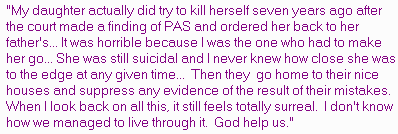 [ANONYMOUS LISTSERVE COMMENT]:
"The MMPI is not a particularly reliable instrument, in the
opinion of many, it is conceptually outdated, and, at best, can only be
used to generate hypotheses that need independent corroboration. You have
none. The SZ scale elevation is not clinically significant, IMHO."
(Illinois doctorate-level MHP, June 8, 2001). [ANONYMOUS LISTSERVE COMMENT]:
"The MMPI is not a particularly reliable instrument, in the
opinion of many, it is conceptually outdated, and, at best, can only be
used to generate hypotheses that need independent corroboration. You have
none. The SZ scale elevation is not clinically significant, IMHO."
(Illinois doctorate-level MHP, June 8, 2001).
Incompetent
Instruments...
[ANONYMOUS LISTSERVE COMMENT]:
"My first order of referral, circa 1993, included a request that I
use objective psychological testing and listed the MMPI, the PORT, and
the BPS. I know how to follow an order and duly purchased the Bricklin
kits. (I was already familiar with the MMPI-2.) A couple years later I
bought Bricklin's The Custody Evaluation Handbook, Research-Based Solutions
and Applications, hot off the press. The references to Neuro-Linguistic
programming aside, and that's a large aside, help me understand the research
that belies these measures. The book doesn't come close. I have been tremendously
disappointed by the lack of research, heck the lack of face validity of
these "measures." Correct me if I am wrong but Bricklin's
MO is to reference "research" that upon closer inspection turn
out to be small pilot studies, at best, and would not pass muster in
a 1st year graduate research course." (Tennessee doctorate-level MHP,
May 27, 2004).
[ANONYMOUS LISTSERVE RESPONSE]: "...the
Bricklin instruments DO have a lot of face validity, i.e. the questions
seem transparently related to parenting. It's reliability and the others
kinds of validity (congruent, convergent & external) that they lack.
Their face validity is exactly what makes non-professionals (i.e. parents
& the legal community) think they're so valuable." (California
doctorate-level MHP, May 27, 2004).
[ANONYMOUS LISTSERVE COMMENT]:
"There are numerous problems with the Abel not the least of which
is that the decision paradigms are trade secrets, they have never been
published and have never been scrutinized by peer review. Someone administers
the instrument, sends the raw data to Abel and they run their stats and
interpret the results. The practitioner essentially never knows how a particular
result was achieved." (New York doctorate-level MHP, June 7, 2005).
[ANONYMOUS LISTSERVE COMMENT/INQUIRY]:
"A recent study by Coffman, Guerin & Gottfried - (2006) Psychological
Assessment, 18, "Reliability and Valdity of the Parent-Child Relationship
Inventory (PCRI): Evidence From a Longitudinal Cross-Informant Investigation,"
p.209-214 advises against using the PCRI in custody evaluations.
Coffman et al. found that for adolescent children (15-16), the PCRI was
valid for assessing concurrent and predictive features of mother-child
relationships, but it was not valid for assessing characteristics of father-child
relationships. Any reactions from the list?" (Michigan doctorate-level
MHP who specializes in child sex abuse accusation cases, usually on the
defense side, August 10, 2006).
[ANONYMOUS LISTSERVE RESPONSE]: "Am
I alone in being troubled by the 5 incredibly transparent social desirability
items on the PCRI?" (New Jersey doctorate-level MHP, August 10, 2006).
[ANONYMOUS LISTSERVE RESPONSE]: "Why
stop there... What about the transparent items on most of the tests we
give... the MMPI-2, MCMI-III, PAI...and don't forget the STAXI, PSI and
CAPI... all these tests have items that are sooo transparent that it's
a wonder they have any utility in custody cases..." (Florida doctorate-level
MHP, August 10, 2006).
[ANONYMOUS LISTSERVE RESPONSE]: "I
am of the opinion that they don't have enough utility in custody cases
to justify their use!!!" (Another Florida doctorate-level MHP, August
10. 2006).
[ANONYMOUS LISTSERVE RESPONSE]: "In
my view, the tests do not have much, if any, utility for predicting
parental competence variables. This would be one reason for defining
CCEs as forensically informed clinical work rather than the other
way around." (Pennsylvania doctorate-level MHP, August 11, 2006).
[ANONYMOUS LISTSERVE COMMENT]:
"I stopped using the SASSI-3 after a father who had failed three outpatient
tx. programs and came to take his pencil-paper testing with alcohol on
his breath scored as not having an alcohol problem on this instrument."
(Doctorate-level MHP, February 28, 2007),
Incompetent
Users...
[ANONYMOUS LISTSERVE COMMENT]:
"[B]ottom line, there are custody evaluators using tests who aren't
competent to do so... More importantly, we have no clue how these people
would respond to the test questions if they weren't in danger of "losing"
a custody battle... or in the case of a dependency case, how they'd do
if they weren't in danger of losing parental rights completely... The context
or demand characteristics of the context are incredibly powerful... so
much so that even victims of DV who are experiencing a multitude of symptoms
are able to produce a profile that's similar to other non-DV victims...
I take a hard-line stance on testing issue because I've seen too of what
I would consider incompetence...pure and simple... and what's worse, the
Court, the attorneys and the parents don't know it unless it's brought
to their attention through rebuttal testimony... yes, I'm aware that testing
is but one element of a custody evaluation... but... when the evaluator
uses the tests inappropriately or doesn't know how to interpret the tests
without a computer generated interpretation, the hypotheses and resultant
recommendations are flawed... " (Florida doctorate-level MHP, April
7, 2005).
[ANONYMOUS
LISTSERVE RESPONSE to an inquiry re testing]: "I ...can't
think of any tests in psychology that are so actuarial and so tightly linked
to a specific behavioral criterion that they are, in effect, self-interpreting.
Actually, most psychological tests involve the application of constructs
rather than behavioral criteria, and the meaning of the constructs in particular
contexts is always open to considerable interpretation." (Michigan
doctorate-level MHP, December 30, 2005).
[ANONYMOUS LISTSERVE COMMENT]:
"I recently testified in a case in which the testifying expert agreed
that the technique he used was not reliable and was not statistically valid
but that he found great value in the information generated by the technique.
He testified that just because something is not reliable does not mean
that it cannot be valid." (North Carolina doctorate-level MHP, February
1, 2007).
[NOTASANONYMOUS LISTSERVE COMMENT]:
"In Illinois and other states, there are evaluators who use 3 and
sometimes 5 actuarial instruments. That way at least one of them will put
the respondent over the 50% mark. You can call this the shotgun approach
or maybe the poison, shoot and firebomb, just in case." (Iowa doctorate-level
MHP, February 2, 2007).
[ANONYMOUS LISTSERVE COMMENT]:
"With nothing in front of him/her but the manual, a good cross-examining
attorney can have a field day with an evaluator who has used the MCMI-III.
Re-read the beginning sections of the manual to get a feel for what you
could be in for. An attorney with the manual and the SEPT can have even
more fun. There are several things to consider in selecting assessment
tools. One of the things to consider is "tactical" -- even if
I find it useful, what will my life be like on the stand if I'm asked to
defend my use of it? I don't think that the Millon passes the "tactical"
test. I recommend the PAI (along with the MMPI-2)" (New Jersey doctorate-level
MHP, February 11, 2007).
...or
Both
[ANONYMOUS LISTSERVE RESPONSE]:
"Maybe I'm missing something... but... when you have data like you've
described, then why even give the SASSI-3 or any other alcohol/substance
abuse scale... the tests are supposed to be used to generate hypotheses
and then extra-test behavior is used to either support or dismiss the hypotheses...
you've got the behavior suggesting a problem and they you're seeking to
support that with the testing?... you seemed to be working backwards..."
(Florida doctorate-level MHP, March 1, 2007).
[ANONYMOUS LISTSERVE RESPONSE]: "...'the
SASSI-3 is designed to be used as an assessment and treatment tool, not
as part of a screening process to reject job applicants or to abridge people's
right and entitlements' ( from the SASSI-3 manual). I don't think it is
too much of a leap to suggest that the tool was not designed for CCE."
(Another Florida doctorate-level MHP, March 1, 2007).
[Good
computer printouts to generate hypotheses about the personalities of people
we don't know also can be got from astrology websites.]
LACK
OF UNDERSTANDING OR APPRECIATION OF DUE PROCESS
[ANONYMOUS LISTSERVE COMMENT]:
"I would challenge you that a refusal to take a drug test... can simply
be discounted ("not held against them")... you have suspicions
of substance use/abuse. I can hardly see how a refusal could alleviate
those suspicions. No matter how positive we can try to be about evaluee
self determination the nagging question... if they're clean like they claim
to be why won't they just demonstrate it?... It's one thing to take a stance
on an issue in general regarding personal privacy. It's another when there
is a microscope focused on you as a parent and you fail to do everything
in your power to demonstrate your fitness as a parent." (Texas doctorate-level
MHP, March 26, 2007).
Arrogance
[ANONYMOUS LISTSERVE COMMENT]:
"When you consider all of this, you realize that those of us who have
some education and some respect for science and rationality live in a very
small and isolated world. The idea that most other people are like us in
this respect is really a ridiculous fantasy... Accordingly, we have trouble
empathizing with people who have grossly misguided fixed ideas. Some of
them are paranoid. But many more are just stupid -- and often very emotional
on certain topics." (California doctorate-level MHP, January 24, 2003).
[ANONYMOUS LISTSERVE QUERY]:
"I would like to know how others have dealt with subpoenas in their
stips. Anyone willing to share? At this point I may state in my stip that
subpoenas be served by mail with a call to let me know it was sent, as
I have 2 offices. L.A. folks any problem with requiring a subpoena be served
by mail only?" (California doctorate-level MHP who had been the court-appointed
"neutral evaluator", now angry and embarrassed that one of the
parties' lawyers had the unmitigated gall to serve her with a subpoena
in the ordinary way, August 10, 2006).
[ANONYMOUS LISTSERVE QUERY]: "To
me, the collective wisdom of this list can trump or at least compliment
advice from an attorney con$ultant. Attorneys give us their opinion that
could be right or wrong. Whatever anyone post is just their
opinion we can ignore or find compelling." (Another California doctorate-level
MHP, August 10, 2006, after the thread went off onto a tangent as to whether
the inquiring MHP had been providing too-detailed case information or requesting
legal advice).
[ANONYMOUS LISTSERVE COMMENT]:
"I am actually teaching the class at the National Council of Juveile
and Family Court Judges' Fall College. Their Child Development guide
is from 1993, only available in photocopy form, and currently out of stock.
I have been told the level of sophistication is relatively low." (Nevada
doctorate-level MHP, August 15, 2006 seeking syllabus suggestions).
[NOTSOANONYMOUS LISTSERVE COMMENT]:
"The article addresses, I believe, the sometimes sharp divide between
judicial decision-making and expert-witness decision-making. Judges, after
all, are ultimately political figures, they seek to represent the collective
social values of the community. We on the other hand represent the intellectuals
in the process." (New York doctorate-level MHP, August 6, 2007).
Ignorance
[ANONYMOUS LISTSERVE COMMENT]:
"The education of judges, attorneys and ourselves is a never ending
process. I was recently in Virginia to testify as an expert witness relative
to gay/lesbian parenting and child custody/visitation issues... Within
seconds, it became clear that the judge did not want to hear from an "outsider"
(I am from Atlanta) and said that he would be more interested in hearing
from me if I had seen the child in question. I had evaluated NONE of the
parties involved but was to testify about the field. The judge and the
"other" attorney seemed to become hung up on what I knew about
standard of care in western Virginia and Virginia." (Georgia doctorate-level
MHP. June 3, 2001).
[ANONYMOUS LISTSERVE QUERY]:
"I have a case in which Mom has said that Dad committed some pretty
sadistic sexual stuff against her. Presumably the kids (young teens) do
not know about this... She is concerned about this information getting
into the report, as Dad shares everything with the kids & they will
learn about it...I believe the information is relevant to the custody issue.
I thought about contacting the judge & asking if I could distribute
the report only to the judge, & I also thought about referring to the
information in the report in vague terms & giving the judge a description
of the details, not to be given to the parents or their attorneys.
I consulted with someone who thought the secrecy (hiding the issue) is
also an issue, & the information should be included in the report &
the report distributed as usual..." (North Carolina doctorate-level
MHP, May 1, 2004).
[ANONYMOUS LISTSERVE REQUEST FOR CLARIFICATION]:
"Would you send the report to the judge first, without copies to the
attorneys, & let him decide if copies should be sent to attorneys?
Or send to attorneys (and judge) with a cover letter advising them to await
judge's order before sharing with parent?" (Another doctorate-level
MHP, May 2, 2004). [Also see, infra, Subverting
Attorney-Client Privilege.]
[ANONYMOUS LISTSERVE COMMENT]:
"APA ethics instruct us to follow State laws. This law was passed
prior to HIPAA being enacted. It is more protective than HIPAA and therefore
has precedence over HIPAA." (Florida doctorate-level MHP, May 29,
2004).
[ANONYMOUS LISTSERVE COMMENT]: "...this
is NOT an evaluation, but a court ordered Reunification Counseling between
the father and 2 daughters. I also left out that the Mother is "Pro
Per". The prevailing thinking I have heard expressed at the mental
health committee meetings in Phoenix is that the client is the court and
the parents nor their counsel are entitled to a therapist's notes, only
the report they generate. One of the top evaluators in AZ has stated he
summarizes each meeting and has successfully defended his objections to
such subpoena's on four occassions by claiming they are "work product"."
(Arizona doctorate-level MHP, May 29, 2004).
[ANONYMOUS LISTSERVE RESPONSE]: "See
also Committee on Legal Issues (APA) Strategies for private practitioners
coping with subpoenas or compelled testimony for client records or test
data. Professional Psychology Research & Practice. 1996. 27 (3) 245-251."
(California doctorate-level MHP, May 30, 2004).
[ANONYMOUS LISTSERVE COMMENT]:
"These issues tend to get polarized, so in the interests of keeping
both the child's need for protection and the parent's need to be informed
front and center, I think it is important to say that the court's intent
should... be protecting the child... the bottom line, the gold standard..
I think our society resolved this dispute about, if my memory serves, 30
years ago with the passage of the legislation that established the state's
right to protect children (what's the precise name of that act?) I think
the issues we are dealing with in family law should be related to that
social policy, and not to anything more amorphous, however well-intentioned."
(New Jersey doctorate-level MHP, May 29, 2004).
Insistence
on Keeping Underlying Data Secret
[ANONYMOUS LISTSERVE QUERY,
similar to literally hundreds posted to the list over a 5-year period,
in which the author tracked this issue in both MHP discussion groups as
well as real-life cases, in which yet another MHP doesn't want to release
that ostensibly special evidence that only an MHP should be permitted to
possess]: "I have a question regarding release of records obtained
during a child custody evaluation. I am reviewing the records of another
psychologist who conducted a child custody evaluation. In the course of
the evaluation, records from the treating physician for one parent and
the child were obtained directly from the psychologist. I received a copy
of the psychologist file... In reviewing the case with the attorney
who retained me it became clear that he did not have copies
of the physician records. He is asking that I release these records.
I am unclear if I can release records to the attorney." (California
doctorate-level MHP, January 25, 2007).
[ANONYMOUS LISTSERVE LAWYER RESPONSE,
similar to literally hundreds of responses from exasperated lawyers over
the same 5-year period to MHPs who just refuse to "get it"]:
"___, you must release them to counsel. You cannot receive or consider
anything that can't be released to the parties and counsel -- due process
trumps all again here. Once privilege was waived to provide the records
for Evaluator I, that waiver continues for the life of the case as to the
court proceedings. Not only can you release them to the parties' counsel,
you MUST do so." (California lawyer, January 26, 2007).
[ANONYMOUS LISTSERVE DEMURRER]: "___,
I didn't receive them direclty. I got them from the psychologist that did
the original evaluation. she won't release them to counsel. I am just trying
to figure out if there is a problem with my giving them to the attorney
that retained me." (Same California doctorate-level MHP, January 26,
2007).
[ANONYMOUS LISTSERVE NONLAWYER]:
"Are you a HIPAA Covered Entity yourself? If so, you may need to get
an authorization. ___ is of course right that everyone has a right to see
everything an expert has used to formulate opinions, but that does not
mean you can violate HIPAA to do it. You may need to get an authorization
first..." (Missouri doctorate-level MHP, January 26, 2007, playing
lawyer).
[ANONYMOUS LISTSERVE NONLAWYER]: "See
how you feel about this approach... Letter to evaluator. This brief note
is to inform you of my intention to provide AWRM with Fill-in-the-blank.
These items were subpoenaed by her and, to the best of my knowledge, neither
you nor Mr. Parent has filed a Motion to Quash..." (New Jersey doctorate-level
MHP, January 26, 2007, also playing lawyer).
[ANONYMOUS LISTSERVE NONLAWYER]:
"I think the answer is to have the attorney send you a subpoena duces
tecum for those documents. As I recall, under HIPAA as filtered through
California state law, even a HIPAA Covered Entity must comply with a subpoena
for Protected Health Information *unless* opposing counsel (who is notified
of the subpoena) formally objects..." (Michigan doctorate-level MHP,
January 26, 2007).
[The
above discussion continued for days, ignoring the California attorney's
clear -- and correct -- advice to a California MHP, mostly with posts hypothesizing
one absurd objection after another to why it wouldn't be a good idea for
a consulting expert to "release" the data she is reviewing to
the lawyer who hired her. A number of the hopeful suggested consulting
a "professional practice attorney" or, in derogation of attorney
work product, consulting with the court, or sending out notices to the
other side. Many became involved in dissecting and interpreting the federal
HIPAA statute, during which another California MHP chimed in to warn everyone
about the differences in state laws.]
[ANONYMOUS LISTSERVE QUESTION]:
"Does any know the definitive word about whether psychologists in
CA are allowed to release psych test data to attorneys (that is, to follow
the 2002 APA ethics code). As I understand the CA rules, the APA
ethics code is part of the rules psychologists live by yet there is some
confusion." (North Carolina doctorate-level MHP, February 28, 2007).
Just
Don't Wanna Release That Report
[ANONYMOUS LISTSERVE INQUIRY]:
"...report is entered, the case is done, the court issues and enters
a final order. About six months later an attorney calls claiming to represent
one of the parties and demands a copy of the report. First, we ask for
verification of who the attorney is and who is being represented. Assuming
the attorney actually is an attorney (this is from another state) and actually
represents the party. should the report be released?" (Florida doctorate-level
MHP, January 8, 2004).
[ANONYMOUS LISTSERVE RESPONSE]: "I
would write to the court (with a CC to attorneys) and explain the series
of events, including the request. I would take my lead from the judge.
Reason: I work at the pleasure of the court. During the time in which I
was engaged in the evaluation, the judge and attorney A and B were involved
in the case. The order under which I was directed to conduct the evaluation
also directed me to release the report to attorney A and B. When Attorney
C comes on to the scene after I have completed by work for the court under
that specific order, I am done. I open my file or I release records or
a report when the judge directs me to..." (North Carolina doctorate-level
MHP, January 8, 2004).
[ANONYMOUS LISTSERVE RESPONSE]: "Is
it not a matter of to whom you turn it all over. This should be anticipated
in the appointment order. Experts hired by one side get the whole chart.
Treating therapists should usually get the evaluation only. Unrepresented
litigants get to review the whole chart only with a licensed mental health
person." (California doctorate-level MHP, January 8, 2004).
[ANONYMOUS LISTSERVE COMMENT]:
"I am in the process of reviewing a report prepared by a custody evaluator.
Printed on each page entirely in caps, in large print, and bolded is the
unambiguous message: 'Not to be released without written permission of
all parties..." (New Jersey doctorate-level MHP, January 17, 2007).
[ANONYMOUS LISTSERVE SUGGESTION]:
"The caution is likely well intended and may be useful in preventing
inappropriate data release to those outside the court system or to treaters
hired by one party. A polite and friendly edifying letter to the
authoring psychologist might be both kind and appreciated." (Illinois
doctorate-level MHP, January 27, 2007).
[ANONYMOUS LISTSERVE COMMENT]: "Maybe
I'm just in an unforgiving mood, but the need to send a 'friendly letter'
that essentially tells the evaluator 'stop lying to people, it's going
to get you in trouble' seems to be confirmation of the ignorance... seems
to indicate the evaluator is ignorant of basic process-of-law issues in
their area. It makes me wonder what other areas of forensic practice the
evaluator is ignorant of...] (Texas doctorate-level MHP, January 27, 2007).
[Some
MHPs, of course, are far brighter than others, but unfortunately that still
just does not fix the problem of the vast majority who aren't -- or the
underlying flaws in the ideas that have injected MHPs into the court system.
And as we can see, given how many have managed to obtain a doctorate from
some school or other, it's not a matter of lack of education, so it would
be silly to propose more education, or procedural guidelines, or ethical
guidelines as a fix (as some have). Even if the problem weren't in the
concept (which it is), once one has attained certain academic levels, it's
just not about more education. And finally, an utterly beautiful example
of hypocrisy... Doctor, doctor, heal thyself...]
[ANONYMOUS LISTSERVE COMMENT]:
"The CA Family Code requires evaluators to review the CPS file, but
does not allow us to make a copy of the file. (We are allowed to
make notes from it, I guess.) In addition to the obvious costs associated
with having evaluators drive out to CPS offices and CPS staff giving access
to the file, there is a serious scientific validity problem. If I
review the CPS records at Time A, something that is not salient to me then
may be salient to me at Time B, when I have more information. If
I'm not allowed to have the records to review at various times, or prior
to drawing conclusions about the case, there is a real risk of loss of
information. The unfairness of holding me responsible for information
that I only get the opportunity to see once, and cannot copy, is obvious..."
(California doctorate-level MJP, February 21, 2007).
Much
Concern for the Copyright Claims of Test Publishers...
[ANONYMOUS LISTSERVE INQUIRY,
topic of repeated discussion over the years]: "How do you retain
"raw data" as privileged (and only released to experts who
will maintain test security and presumably not misuse or misinterpret data)..."
(Tennessee doctorate-level MHP, May 29, 2004).
[Often
incorrectly citing to, interpreting, or even reading various statutes and
regulations, the recalcitrants argued, inter alia, that they had
"ethical obligations" (apparently higher in their own minds than
due process) to maintain test publishers' nonexistent "trade secrets"
(in commercial product widely published, sold, and disseminated, including
to competitors), that the test materials were copyrighted and thus could
not be produced in discovery, that litigants and/or their attorneys were
obligated first to hire a consulting MHP to "receive" and explain
and retain possession of the sacred texts in order for them to be produced,
that the materials could only be produced "in camera" or else
only to the lawyers but not those agents' employers (their clients), or
else required a detailed specific additional court order (a mere attorney
subpoena not being good enough), and similar nonsense. Some actually crowed
that they had convinced judges to issue protective orders (especially against
pro se litigants), on theories which included, among others, paranoid speculations
that litigants would rush out to publish psych test questions all over
the place, coach their friends, and other fantasies of "misuse".
Not infrequently, they considered the litigants' lawyers to be incompetent,
unprepared, or naive. (Some undoubtedly are, or else are more concerned
about their referral relationships than their clients.) In any event, few
MHPs reported that their abominable behaviors and frivolous positions were
sanctioned, or that protective orders they won at the expense of the parties
were appealed. Ostensibly this stood as proof that everyone recognized
the righteousness of the MHP's position. (The more likely reason, unrecognized
by the clueless, is that the litigants and lawyers compromised, prioritized,
and triaged with limited time and resources. Litigants already overwhelmed
in an expensive, stressful, and potentially life-altering ordeal rarely
can afford to hold up their and their children's very lives and the resolution
of their divorce and custody cases in order to divert time, money, and
effort to making law for the benefit of the next guy.)]
[ANONYMOUS LISTSERVE COMMENT]:
"The attorney is perfectly capable of buying the manuals if he/she
needs them. I wouldn't turn over a manual any more than I would give out
any other books off of my shelf. At most, supply the references and where
the manuals may be purchased." (Texas doctorate-level MHP, February
18, 2005).
[ANONYMOUS LISTSERVE RESPONSE]: "wow,
and I thought I was the only one who told those folks to go buy the damn
things themselves or get the psychologist on their staff or in their pocket
to get it. Bottom line: they want, they get it; or, they get a Judge to
order me to give it up, in which case I get the test purveyor involved
and direct all further communication between test purveyor's legal counsel
and the Judge. Whew, what a crock" (Pennsylvania doctorate-level MHP,
February 18, 2005).
...
but not for the Copyright Claims of Article Publishers
[ANONYMOUS LISTSERVE REQUEST,
similar to hundreds made on the anonymous listserve over nearly six years,
perhaps thousands if "backchannel" requests and multiple requests
per article were to be counted]: "I am interested in obtaining a copy
of the recently cited study concerning grandparents involvement in: J Family
Psych (2002)... I do not subscribe to this journal. Can anyone email or
fax me a copy?" (California doctorate-level MHP, January 31, 2003).
[ANONYMOUS LISTSERVE ME-TOO]: "Any
possibility I could acquire the same, but through e-mail. I just received
notification yesterday about a grandparent case here in VA ...judge wants
some input. Thanks..." (Virginia doctorate-level MHP, January 31,
2003).
ANONYMOUS LISTSERVE REQUEST]:
"Would anyone on the list who has access to the American Journal of
Psychiatry please contact me backchannel." (Texas doctorate-level
MHP, February 15, 2007).
Paternalistic
Attitudes Toward Litigants (and More Time/Money Wasting)
[ANONYMOUS LISTSERVE COMMENT]:
"It is because of just this problem with pro se parents (who, I believe,
are entitled to the report because they are their own attorneys), I refuse
all pro se cases. If a parent goes pro se mid-eval, I make a case-by-case
decision since by then I have some sense of the kind of person I'm dealing
with.." (New Jersey doctorate-level MHP, June 6, 2001, who refuses
to release her custody evaluation report under any circumstances in which
the principal in the attorney-client agency relationship might get a copy).
[ANONYMOUS LISTSERVE RESPONSE]: "I
guess the parent, represented or not, has three levels of rights. They
can have it explained to them, read it and return it, or get a personal
copy. In my case they will have it read to them only if the court allows.
Even giving it to one of these parents could create a problem as force
would probably be needed to get it back." (California doctorate-level
MHP, June 7, 2001).
[ANONYMOUS LISTSERVE FOLLOWUP]: "In
the cases I've had where parents had counsel and I thought there was a
risk to the child (or myself) from allowing the parent to read the report,
I asked the judge to have counsels read it in chambers and summarize to
parents." (New Jersey doctorate-level MHP, June 7, 2001).
[ANONYMOUS LISTSERVE RESPONSE]: "...there
is a difference between not giving a client information for a psychological
service and not giving the person a report that has been orally explained
to them. Respectfully, ___" (California doctorate-level MHP, June
7, 2001).
[The
subject of not allowing litigants their simple due process rights to confront
the evidence against them was a repeated theme on the listserve over the
years, whether by not letting the parties have a reasonable opportunity
to ponder and digest the evaluator's report, by not disclosing some aspect
of the underlying data upon which the evaluator based his opinion, by standing
on imaginary rules such as that the data may only be turned over to another
MHP specifically hired for the purpose, by claiming that subpoenas weren't
sufficient and "court orders" were required, by trying to discover
some reason HIPAA or ethics or the psych board would not permit it, by
asserting that this was not the evaluator's obligation per his "stip",
by resisting deposition and the request to testify under certain circumstances
(especially if not paid yet more), by hypothesizing that there might be
a danger to collateral witneses or third parties or children if information
were to be released, by handwringing over the awful prospects of the report
being "misused" if it got out, by speculating that there would
be some ethical breach toward test publishers, and much other hopeful bogus
crap. Based on the majority of the evaluator reports this author has seen
in her practice, it's not surprising that many MHPs would not want their
canned formulaic unscientific nonexpert drivel to be published where it
could be shredded for the nonsense it is. Especially those who write similar
biased findings in similar ways over and over again. In fairness, the author
occasionally has seen custody evaluation reviewers' reports that
were impressive (then again, these reports are done for very different
purposes, and they only highlight even more how pointless and wasteful
this entire process is.]
{ANONYMOUS LISTSERVE COMMENT]:
"When I have a legitimate concern about possible or probable harm
in releasing the report, I indicate this concern in the report and put
the burden on the attorneys to use good judgment. If one or both parties
are pro per, I release the report only to the court (possibly sending only
the recommendations to the attorney/pro per), along with a letter explaining
the problem and asking the court's guidance as to whom to release what.
Of course, I copy the pro per and attorney so that they are appraised of
the situation and either may bring a motion before the court to resolve
the problem." (California doctorate-level MHP, June 11, 2001).
[ANONYMOUS LISTSERVE COMMENT]: "The
San Diego Rules of Court specifically state that parents are not to be
given a copy of the eval report. When I first meet with clients, I tell
them the rules of court, I tell them the reason for the rule, give them
examples and tell them they can read the entire report in their attorneys
office. When a parent is pro per, I send them a copy of the summary and
recommendations and tell them they can come into my office to read the
full report. If a client insisted on having a copy (if they are pro per)
I would give it to them. So far, no one has asked. They seem to accept
the reasonableness..." (California doctorate-level MHP, June 11, 2001,
stating a rule of court that if true, is astonishing, even obscene, in
its derogation of due process rights, leading one to wonder who would have
suggested this and why, and who in his right mind in charge of the court
procedures would have gone along with it).
[NONASANONYMOUS LISTSERVE COMMENT]:
"In one case, I wrote to the judge, expressing concern that the information
could prove harmful if released to 'the wrong people.' The judge allowed
me to send the information to him, & it was retained by the court,
sealed. The attorneys looked at it there." (California doctorate-level
MHP, February 2, 2007).
Role
Confusion and Power-hungry Incompetence
[ANONYMOUS LISTSERVE QUERY]:
"I am working with a divorced couple... two teenage girls... reside
with one parent... The non-residential parent pays child support to the
residential parent. They are struggling with expenses that seem beyond
normal daily expenses, such as prom dresses, volleyball camp, special trips
out of town, etc.The parent who pays child support is of the opinion that
all those expenses should come out of child support, but the other parent
thinks that those expenses are beyond child support and that they should
be shared equally." (Doctorate-level MHP, June 2, 2001).
[ANONYMOUS LISTSERVE RESPONSE]: "As
an evaluator I would strongly recommend that the court's order about these
expenses be explicit, thorough and clear without taking any other stance
on what that order should be. (Illinois doctorate-level MHP, a physician,
June 2, 2001, who apparently advises judges in his jurisdiction on how
to make decisions and draft court orders.)
[ANONYMOUS LISTSERVE RESPONSE]: "If
this was a chronic situation and the more well-to-do parent really wanted
the kids to have things that the other parent could not afford, I might
refer the parties back to counsel with the suggestion that they pursue
some kind of creative option - i.e. the creation of a special account for
these issues, which could be accessed only with the consent of both parents
or the order of the special master... Obviously, many high conflict families
can't handle this, in which case I agree with everyone who says that insulating
the kid from the conflict trumps letting her have the prom dress..."
(California doctorate-level MHP, June 2, 2001).
[The
last opiner apparently fantasizes that she has the right to decide that
someone else's teenage daughter may not attend her one-and-only senior
prom, as well as to deny other free law-abiding citizens their right to
go to court to settle a dispute and litigate fairly cut-and-dried child
support issues... wonder how that "insulates the kid from conflict"...
wonder how many prom dresses could be purchased for the cost of a custody
evaluation...]
[ANONYMOUS LISTSERVE COMMENT]:
"Custody Evaluation = voluntary or involuntary exposure to a one time
intervention, with no confidentiality expectation, that may recommend one
or more of the first three interventions in the context of best interests
of the child." (Pennsylvania doctorate-level MHP, January 18, 2004).
[ANONYMOUS
LISTSERVE QUERY]: "A colleague has asked my opinion on this
issue, and I don't think I've ever thought about it before: he is
the therapist for a highly contentious post-divorce couple. They have returned
to court 32 times on one issue or another. My friend is growing frustrated
because he has no authority to make change happen, he can only work
with the couple to help them grow themselves. In talking about the case,
I said I thought he should switch to being their Special Master."
(California doctorate-level MHP, December 23, 2005).
[Why
would it not be a simpler and more adequate -- certainly cheaper and less
intrusive -- solution to just let one of the parents make the decisions.
Bet the child's primary caregiver is feeling pretty frustrated too. The
above items also could have been placed under a number of the above categories,
such as Lack of Science and Lack
of Decision-Making Ability. Also compare the quote under Outright
Bias, supra, with this last item]
[ANONYMOUS LISTSERVE
COMMENT]: "If a custody evaluator hasn't kept up on potentially-relevant
diagnoses and isn't used to thinking in diagnostic terms, he or she should
probably not make a diagnosis without consultation. The appropriate recommendation
would be that there be a formal evaluation of the individual by a psychologist
or psychiatrist who regularly does such evaluations to ascertain whether
a parent has a disorder to a degree that may have a significant negative
affect on the child(ren)." (Wisconsin doctorate-level MHP, February
11, 2007).
Messing
with stepparents and second marriages
[ANONYMOUS LISTSERVE
COMMENT]: "...I think that we can at least say something about the
red flag that this kind of event raises: the step-parent's failure to participate
means you cannot report fully..." (Texas doctorate-level MHP, November
9, 2007).
[ANONYMOUS LISTSERVE COMMENT]: "I
respectfully disagree. If the stepfather will not participate, all you
know is that he won't participate. You don't know why..." (California
doctorate-level MHP, November 9, 2007).
[ANONYMOUS LISTSERVE COMMENT]: "Stepfather
may just be following lawyer's advice, which may be good, bad or indifferent.
Drawing any inference whatsoever is prohibited bias" (California attorney,
November 9, 2007).
[ANONYMOUS LISTSERVE COMMENT]: "A
stepparent can be compelled to testify as a fact witness..." (Michigan
doctorate-level MHP, November 9, 2007).
[ANONYMOUS LISTSERVE COMMENT]: "What
I did was to state in the report that the step-parent would not participate..."
(California doctorate-level MHP, November 9, 2007).
[ANONYMOUS LISTSERVE COMMENT]: "I
simply wrote the Judge, xc'd both attorneys and within two weeks the Judge
reissued the order and voila... stepparent showed up and was a cooperative
participant." (Texas doctorate-level MHP, November 9, 2007).
[ANONYMOUS LISTSERVE COMMENT]: "I
usually request participation of the 'significant other'..." (Canadian
doctorate-level MHP, November 9, 2007).
[ANONYMOUS LISTSERVE COMMENT]: "Have
you tried bringing this to the attention of the attorneys? You are now
making it sound like stepfather's motivation, although admittedly somewhat
unrealistic, might be a more normative motive of protecting himself and
his and his kid from someone he sees as hostile. Perhaps someone just needs
to explain to him that this isn't a choice..." (California doctorate-level
MHP, November 9, 2007).
[ANONYMOUS LISTSERVE COMMENT]: "...if
we work in a court system that routinely expects the evaluator to provide
a custody recommendation, can we ethically (from a practice standpoint)
do so if we have no first hand information about a parenting figure..."
(Indiana doctorate-level MHP, November 11, 2007).
[ANONYMOUS LISTSERVE COMMENT]: "It's
important that we try not be more cavalier than the courts about 'automatic'
waivers of rights, particularly rights that have some constitutional weight
behind them, such as privacy rights. Stepparents do not lose their individuality
or their legal autonomy..." (Michigan doctorate-level MHP, November
14, 2007).
[ANONYMOUS LISTSERVE COMMENT]: "So
you're implying that the Texas statute is what, unconstitutional, because
it makes the child who is the subject of the suit the center of determining
who is relevant to the child's best interests?" (Texas doctorate-level
MHP, November 14, 2007).
[ANONYMOUS LISTSERVE VEERING]: "You
mentioned the step-sib? As in... little Susie (who is the focus of this
eval) lives with her mother and step-siblings from her step-father's first
marriage..." (California doctorate-level MHP, November 14, 2007).
Self-interest
(and Self-Importance) above Due Process
[ANONYMOUS LISTSERVE INQUIRY]:
"I received a subpoena Duces Tecum today for my notes, records, etc
in a case where I am the court ordered therapeutic interventionist assigned
with doing reconciliation counseling. If I work for the court/TOF in this
case, how do I argue EFFECTIVELY that my notes are "work product"
to prevent them from being obtained?" (Arizona masters-level MHP,
May 29, 2004).
[ANONYMOUS LISTSERVE RESPONSE]: "The
SDT is only a command to produce at a hearing, not give them up. It is
there that you make your argument to the Judge suggesting that the notes
may be damaging to the process...request that the court examine them in
camera (Sp?). ...focus on arguing the negative impact... damage to the
process is the most important issue." (Missouri doctorate-level MHP,
May 27, 2004).
[ANONYMOUS LISTSERVE RESPONSE]: "Can't
a parent's normal legal right to a minor child's records be pre-empted
by a court's judgment that this would not be in the best interests of the
child?" (New Jersey doctorate-level MHP, May 27, 2004).
[ANONYMOUS LISTSERVE RESPONSE]: "Yes,
if the parties stipulate to this or under some other circumstances... at
the time the order for therapy was signed... After the fact, the psychologist
lacks standing with the court to bring motions on the child's behalf unless
she was appointed some kind of guardian ad litem or special master under
the terms of the appointment order..." (Michigan doctorate-level MHP,
May 29, 2004).
[ANONYMOUS LISTSERVE RESPONSE]: "In
Florida, we can legally refuse to release notes, arguing that they are
"raw data" just like test responses. It is the option of the
psychologist, and is made on the basis of the notes being detrimental to
the parties if released. " (Florida doctorate-level MHP, May 29, 2004,
giving incorrect legal advice to his colleagues.)
[ANONYMOUS LISTSERVE RESPONSE]: "In
one case, I wrote to the judge, expressing concern that the information
could prove harmful if released to "the wrong people." The judge
allowed me to send the information to him, & it was retained by the
court, sealed. The attorneys looked at it there." (Doctorate-level
MHP, May 29, 2004).
[ANONYMOUS LISTSERVE RESPONSE]: "With
disturbing frequency, I have encountered posts that make some reference
to situations in which pertinent documents (the contents of which might
very well determine the outcome of a case) are shown to attorneys in chambers
and the attorneys are discouraged from discussing the contents of these
documents with their clients. Can anyone imagine something like this
occurring in a context other than the family law context (or under the
terms of the Patriot Act, perhaps)... Am I being misled by selective perception
or selective recall, or am I correct in my impression that issues such
as this pop up here frequently? Litigators are not generally known for
their passivity. If my impression is correct, that the due process rights
of litigants in family-related actions are often ignored, why has there
been no revolt?" (New Jersey doctorate-level MHP, May 29, 2004).
[ANONYMOUS LISTSERVE RESPONSE]: "IMO
it is quite patronizing as well as grossly unfair not to let clients see
everything that pertains to them and their case. I would be enraged if
I were a litigant and this happened to me." (Minnnesota masters-level
MHP, May 29, 2004).
[ANONYMOUS
LISTSERVE INQUIRY]: "A friend of mine, who had done a number of CCE
in Illinois, moved to another state 6 months ago. She said she gave 6 months
notice to all participants about the move. I believe she completed all
CCE's before leaving. She now reports that she has been ordered back to
Illinois to give a deposition and the judge has refused her request to
have the parties pay for her air fare and lodging. Does the judge have
the power to order her to comply now that she lives in a different jurisdiction?"
(Illinois doctorate-level MHP, January 19, 2006).
[The
above item was also a candidate for the Arrogance
category. There are so many defects in thinking, it's difficult to come
up with a categorization scheme -- perhaps this author ought to consult
with the drafters of the DSM... Perhaps the MHP should just be thankful
that she didn't have to hire a lawyer, file a petition, pay for a psych
evaluation, prove her good reasons to move contrary to the interests of
other persons, and beg the judge for permission while one of her cases
was still pending in the court...]
{ANONYMOUS LISTSERVE QUESTION]:
"Can anything be done about being served with a custody related subpoena
at your personal unlisted residence... If so served, what might you do?"
(California doctorate-level MHP, February 3, 2007).
Self-interest
as the Highest Priority
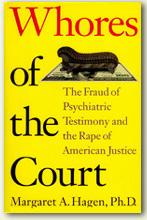 Note
to all parents, public, lawyers and judges: Prof. Hagen currently is offering
a FREE DOWNLOAD pdf file from her website. GET IT, READ IT. If
you're short on time, read the beginning and Chapter 8. -- liz Note
to all parents, public, lawyers and judges: Prof. Hagen currently is offering
a FREE DOWNLOAD pdf file from her website. GET IT, READ IT. If
you're short on time, read the beginning and Chapter 8. -- liz
[ANONYMOUS LISTSERVE QUERY]:
"Someone has asked me if there has been some kind of policy change
in New York (either by case precedent or policy of a professional organization)
that would have the effect of precluding a psychologist from making a custody
recommendation, even from the position of court-appointed evaluator. Do
any of you know anything about this? ...It was also suggested that some
kind of policy put out by APA on this issue, suggesting that psychologists
have no more expertise than lay people to make such recommendation..."
(California doctorate-level MHP, December 25, 2003).
[ANONYMOUS LISTSERVE RESPONSE]: "I
just ...attended a NY judicial institute at which high on the food chain
judges talked about the past present and future directions in family law
and procedures, no one mentioned this as a possibility on the horizon.
One thing that was talked about was a move in the direction of Parent Coordinators
or Special Masters... and there was talk that a special master could not
have input as to custody recs after serving in that capacity." (New
York Doctorate-level MHP, December 26, 2003).
[ANONYMOUS LISTSERVE RESPONSE]: "Parent
coordination is mediation/arbitration. Usually reports are made to the
Court and coordinators testify and have access to all attorneys, therapists,
parties, etc... Check out the AFCC Parenting Coordinator Task Force Report
in the Members Only section of the AFCC website. The Task Force is working
on standards as we speak..." (Louisiana masters-level MHP, December
26, 2003).
[ANONYMOUS LISTSERVE FOLLOWUP]: "If
parent coordinators have no arbitration or decision making powers - what
is their role? Most places that use them seem to hope that this model will
keep people out of Court and slow the re-litigation rate." (Louisiana
masters-level MHP, December 26, 2003).
[ANONYMOUS LISTSERVE RESPONSE]: "I
understand that is the hope, and I believe the inital intent. Florida Psych
Association is supporting legislation proposed by FL AFCC to introduce
PC into legistlation. Right now it is circuit by circuit in Florida. I
don't know about other states. In my circuit there was an oriingal conceptualization
that PC was1/2 therapy and 1/2 mediation. In order to be appointed , one
had to be both a certified mediator and licensed mental health professional...
" (Florida doctorate-level MHP, December 26, 2003).
[ANONYMOUS LISTSERVE RESPONSE]: "Yes,
that is their hope. Special masters in CA have decisionmaking power. The
problem here is that the parties have to stipulate to having a special
master...sometimes the court creates incentives for that to happen..."
(California doctorate-level MHP, December 27, 2003).
[ANONYMOUS LISTSERVE FOLLOWUP]: "The
first orders I saw in the 4th circuit were lenghty and very specific, since
then attorneys have been drafting to suit the needs of the situation and
IMHO have confused the issue. My iniital understanding was that the PC
had a great deal of power vested." (Florida doctorate-level MHP, December
26, 2003).
[ANONYMOUS LISTSERVE RESPONSE]: "'Parenting
Coordination: Implementation Issues, April 30, 2003," (AFCC Task Force
on Parenting Coordination). Family Court Review, Vol. 41, No. 4, October
2003, 533-564..." (Pennsylvania doctorate-level MHP, December 26,
2003).
[ANONYMOUS LISTSERVE RESPONSE]: "In
our corner of the world, we have decision making power, you do not
have to be a mediator, but you must go through 24 hours of training
and participate in peer supervision... some of the cases are VERY INTERESTING...
We also looking toward putting PC up for legislation. There is so
much work to be done to do it, but we have a number of lawyers and several
judges invested in the process." (Washington doctorate-level MHP,
December 26, 2003).
[ANONYMOUS LISTSERVE RESPONSE]: "I
am very interested in this issue, both clinical forensically and legislatively.
Could you say more re: decision making. Has the court vest its power; what
clout is behind the decisions; how has legal community reacted?" (Florida
doctorate-level MHP, December 26, 2003).
[ANONYMOUS LISTSERVE RESPONSE]: "I've
talked about this on the list before. It's an ambiguous mess from an ethical
viewpoint..." (Colorado doctorate-level MHP, December 26, 2003).
[ANONYMOUS LISTSERVE RESPONSE]: "I'm
involved with setting it up. Can you back channel me with the info you
got at the Judicial Institute. E.g., who presented? What info?..."
(New York doctorate-level MHP, December 26, 2003).
[ANONYMOUS LISTSERVE RESPONSE]: "My
close work with PC's here suggests that the good ones have a very clear
idea that they are in a quasi-judicial role - in fact, at one of our trainings
the speaker told us to look at the judicial canons of ethics - and that
first and foremost among their responsibilities is to be able to reach
decisions relatively quickly..." (California doctorate-level MHP,
December 27, 2003).
[ANONYMOUS LISTSERVE RESPONSE]: "The
same/similar role has different names in various places - many states are
moving toward standardizing the title Parent Coordinator (as used by Garrity,
Baris, Coates et al in their several books). Phil Stahl - who used to do
the work and no longer does - loved to tell people how this role was called
Wise Person in New Mexico!" (Louisiana masters-level MHP, December
27, 2003).
[ANONYMOUS LISTSERVE RESPONSE]: "WPWP
wise person with power" (Florida doctorate-level MHO, December 28,
2003).
[During
2001-2006, literally thousands of posts to the anonymous listserve dealt
with promoting the parenting coordination idea, as well as promoting AFCC
generally, and establishing AFCC (essentially a trade organization) as
the arbiter of self-regulation guidelines for parenting coordination and
custody evaluation. Much potentially lucrative work is at stake. Inasmuch
as the process involves possibly unconstitutional delegation of judicial
powers where not agreed to by the parties and a considerable number of
other problems, as well as getting the judicial and legislative branches
of government on-board, establishment of the concept has been slow-going.
However, many judges and lawyers, swayed by the propaganda and lobbying
in its favor, have bought into the dangerous concept. In addition to the
promotion, a considerable amount of practice discussion also involved not
only risk management by avoiding misfeasance and malfeasance, but also
the affirmative lobbying for immunity protections for GALs, CCEs, and PCs,
infra, as "quasi-judicial" officials (unlike lawyers,
who have no immunity, and unlike judges who are overseen by appellate courts.)
A lot of crabbing also ensued comparing the hourly rates of lawyers (who
do not have immunity, who cannot summarily refuse to work if they aren't
paid, and who have considerable overhead) to MHPs' own fees.]
Self-Protection
Above All
[ANONYMOUS LISTSERVE
REQUEST]: "Could any of you in states who have such statutes... protecting
CCE's from Board complaints... email me copies of your statutes? And I
suppose any other info that would be helpful in supporting such legislation.
I am starting to talk to some folks in CA about introducing such legislation...
so would be extremely helpful to see what other states have done. Also,
do any of these statutes provide protection for psychologists who do court-ordered
therapy in family law cases, or just CCE's?" (California doctorate-level
MHP, January 16, 2004).
[ANONYMOUS LISTSERVE COMMENT]:
"I'm gradually realizing that a recommendation admired in one jurisdiction
might be disdained in another. I'm taking more care to learn about local
custom before making recommendations." (California doctorate-level
MHP, May 25, 2004).
[ANONYMOUS LISTSERVE COMMENT]:
"The ongoing references to board complaints and exposure in CCE during
the conference was unsettling." (Tennessee doctorate-level MHP, May
26, 2004).
[ANONYMOUS LISTSERVE INQUIRY]:
"So what would you advise in this situation: Judge changes custody
and orders that the parent who lost custody have no contact with the children.
Judge appoints a therapist for now custodial parent and children. In the
order, gives the therapist the right to decide which members of the family
to see, including the parent who lost custody if deemed therapeutically
advisable. The order also gives the therapist the right to decide whether
or not confidentiality should be violated in the best interests of the
children. Parent who lost custody is appealing. The record indicates that
the parent who lost custody has a history of making unsubstantiated and
legally dismissed allegations of various sorts to various relevant authorities...
The therapist does not think it is advisable to involve that parent in
the treatment at this point. The rationale is that the children are just
beginning the process of adjusting to the change and the therapist's role
is to foster that adjustment. Would best risk management practice... be
for the therapist to initiate contact or not with the parent who lost custody?
Does initiating contact trigger a duty of care? Does not initiating contact
violate any parental rights or other obligation to the parent? Other issues?"
(New Jersey doctorate-level MHP, May 29, 2004).
[ANONYMOUS LISTSERVE FOLLOWUP]: "When
a Guardian Ad Litem is appointed, does this do the job? i.e., does the
GAL "hold" the children's rights even when their parents are
both alive and involved and no parental rights have been terminated? I
don't understand why you are conceptualizing the children's rights as due
process rights." (New Jersey doctorate-level MHP, May 29, 2004).
[ANONYMOUS LISTSERVE QUERY]:
"Hi all, Do any of you know what the latest pronouncements are from
APAIT regarding insurance coverage for parent coordination?" (California
doctorate-level MHP, February 2, 2007).
[ANONYMOUS LISTSERVE QUESTION]:
"I have a friend who's had 3 board complaints in CCEs and is looking
at a likely fourth. All 3 have been dismissed with no sanction by the board.
Large legal bills to defend the complaints have all been covered by the
same insurer, about $35K total. My friend fears that there may be a point
where malpractice insurers refuse to renew coverage simply because of a
certain number of claims.." (Missouri doctorate-level MHP, February
2, 2007).
[ANONYMOUS LISTSERVE QUERY]:
"Moreover, if someone actually rules that PC is not the practice of
psychology, is the psychology malpractice carrier still obliged to defend
us?" (California doctorate-level MHP, February 5, 2007).
[ANONYMOUS LISTSERVE RESPONSE]: "I
would hope that the question would become moot. The Oklahoma statute
grants the PC quasi-judicial immunity, which should eliminate a malpractice
lawsuit... recourse for consumer protection would be to file a grievance
with the court... The court can decide to remove this individual [as PC]...
I believe that is sufficient protection for the consumer." (Oklahoma
doctorate-level MHP, February 5, 2007).
[ANONYMOUS LISTSERVE COMMENT]:
"We have a local evaluator who makes the litigants sign a statement
on the last evaluation day that says the evaluation was competent, fair
and they have no concerns...of course, if there's a review, he parades
the signed statement "proving" there's no problems..." (Florida
doctorate-level MHP, February 6, 2007).
[ANONYMOUS LISTSERVE COMMENT]:
"Right. And that's the reason that I have such trouble with
___ (or anyone) taking the position that PC is not the practice of psychology...
Should ___ prevail in his position and obtain a ruling that PC practice
is not the practice of psychology, he may well undermine insurance coverage
for all psychologist PC's in his own state as well as others." (California
doctorate-level MHP, April 17, 2007).
[NOTSOANONYMOUS LISTSERVE COMMENT]:
"PSYCHOLOGIST SELF-PROTECTION OVER THE EDGE: THE ABSURDITY OF 911
VOICEMAIL WARNINGS Alan Karbelnig, Ph.D. National Psychologist, May/June
2007 Hopefully signaling the peak of an epidemic of excessive self-protection,
many psychologists now sport recorded voicemail messages that advise callers
to hang up and dial 911 in case of medical emergency. Such warnings presumably
inform unwitting callers that psychologists cannot provide emergency medical
services. These 911 outgoing messages must be proliferating out of fear
that psychologists could be sued by someone who expected to find cardiac
defibrillation, gastric lavage, suturing, or other emergency medical procedures
at the end of psychologists' phone lines. Failing to do so, these psychologists
fear, callers could become injured in some fashion and then sue them for
negligence. Yet no such legal, ethical, or commonsensical protective standard
for psychologists exists...".
[ANONYMOUS LISTSERVE COMMENT,
referring to a news story about arrest of a noted child custody psychologist
for allegedly outrageously violating a woman's privacy by secretly videotaping
her using the toilet in his office bathroom -- bothered NOT by the
incident or the egregious apparent violation against this woman, but that
the psych board program manager gave a media interview]: "What disturbs
me is this part: '...Tammy Kelley, disciplinary program manager with the
Department of Health's psychology board.' Nothing done legislatively will
ever solve the 'loose lips' problem, but when the Program Manager discloses
information concerning complaints that have been dismissed..." (New
Jersey doctorate-level MHP, July 14, 2007).
[ANONYMOUS LISTSERVE COMMENT]: "I'm
sure this is a state by state issue as to what the board is able to disclose,
but it's far from the worst horror story I've heard..." (Texas doctorate-level
MHP, July 14, 2007).
[ANONYMOUS LISTSERVE COMMENT]: "This
is indeed disturbing. I'm sure Stu has bigger things on his mind right
now, but I wonder if this disclosure was legal." (California doctorate-level
MHP, July 14, 2007).
Also
see "Sex Positivism".
Note that some of the dismissed psych board complaints alleged bias against
a mother custody litigant. Three of the six cases were placed under seal.
And the problem is that... the public, or these complainants now can compare
notes? as did these women, re a Texas
evaluator? One of the problems when litigants make allegations of bias
in an isolated case is they are not able to prove it by showing a pattern
of bias. Bias can be very difficult to prove. By analogy, it was for this
reason that the EEOC started doing statistical analysis in cases of employment
discrimination. And it also is for this reason, inter alia, that
this webpage exists and the instant research has been undertaken.
Subverting
Attorney-Client Privilege
[ANONYMOUS LISTSERVE COMMENT]:
"...it makes sense to me that the pre-testing (if it is actually destined
to be such) would not be priveleged...I don't see how this 'pre-testing'
could be protected because, as an agent of the court, the psychologist
performing the subsequent cce would request, and be within his or her right
to receive anything in the attyorney's file relevant to the client's psychological
status." (Florida doctorate-level MHP, January 19, 2003).
[ANONYMOUS LISTSERVE COMMENT]: "The
client may have different stressors by the time the CCE rolls around than
when they took your MMPI-2 in this pre-eval context. However, when clients
have been coached on these measures, it really does limit the CCE evaluator's
ability to derive anything from the profile. To avoid these concerns, I
must suggest to go back to the standby -- nothing better than a thorough
history taking and well documented observations." (California doctorate-level
MHP, January 20, 2003).
[ANONYMOUS LISTSERVE QUERY]:
"I am conducting a CCE and am faced with some unusual circumstances.
One of the litigant's attorneys has done some questionable things which
I have brought to the attention of the court (and all involved).
My concern is whether parent represented by the attorney understands how
potentially damaging this attoreny's actions are going to be for their
case..." (New York doctorate-level MHP, October 8, 2006).
[ANONYMOUS LISTSERVE COMMENT]:
"I may also include in my order a requirement that, even if the attorney
were to learn of my home address, that it not be released to litigants."
(California doctorate-level MHP, February 5, 2007).
[NOTSOANONYMOUS LISTSERVE]:
"According to Shuman (D.W., 2001,Psychiatric and Psychological Evidence,
2nd edition) and probably other sources, the attorney-client privilege
"typically recognizes an exception or exclusion relating to the the
performance of future crimes". Is it reasonable to conclude from the
above when a defense counsel retained forensic psychologist acquires reasonable
suspicion of child abuse by the defendant, the future-crimes exception
to attorney-client privilege dictates in favor of the psychologist reporting
suspected child abuse over the psychologist's duty to honor attorney-client
work-product privilege?" (Colorado doctorate-level MHP, April 15,
2007).
[NOTSOANONYMOUS LISTSERVE]:
"...got a call from an attorney to eval her client. She said there
may be more abuse that her client had not been caught for. I told her I
had duty to report and she claimed I could not becuase of attorney/client
priveledge. I told her this issue had not been clearly resolved in the
forensic arena and only recently had been to an ABFP workshop (that was
back in 2003 I think) where it was discussed with the presenter and even
he said it's not clear-cut. She got really pissed at me and kind of disparaging...
one has to decide which stance to take. I, personally, would adhere to
the law of being a mandated reporter and adhere to my penchant for being
a child-advocate..." (South Dakota doctorate-level MHP, October 15,
2007).
[NOTSOANONYMOUS LISTSERVE]: "I agree
one has to decide, but I would bet dollars to donuts (which is getting
close to even money) that in some jurisdictions you'd better decide to
tell people you're going to report. I'd bet that many licensing boards
don't think you stop practicing psychology just because you are working
for an attorney." (Doctorate-level MHP, October 15, 2007).
"Mandatedly
reporting" childhood abuse of a 22-year-old criminal defendant.
[NOTSOANONYMOUS LISTSERVE
INQUIRY]: "During the clinical interview the defendant (age 22) discloses
to the expert that he was sexually molested by a relative when he was age
4. Defendant discloses the city the relative lives in. The expert calls
the police department of the city where the relative lives immediately
after leaving the defendant and reports the abuse. Is this reporting ethically
mandated? Since this psychologist was retained by the defense, did the
psychologist violate attorney/client privilege? Would it have been simply
courteous to give the attorney a "headsup" before calling the
police? Was the call to the police necessary considering the statute of
limitations has expired?" (Massachusetts doctorate-level MHP, a criminal
forensic, March 8, 2007).
[NOTSOANONYMOUS LISTSERVE RESPONSE]:
"This is such an interesting question. I have heard several responses
to this question and they all revolve around the idea that depending on
what attorney and his/her specialty, recommendations may be different.
One perspective I have heard is that a constitutional attorney would argue
that the evaluator's responsibility is to the attorney and that no reporting
should occur without the retaining attorney's blessing.Another perspective,
often provided by a malpractice insurance attorney is to report since the
statute directs such reporting. Me? I would anticipate such a concern and
include in my retainer..." (North Carolina doctorate-level MHP, a
custody evaluator, March 8, 2007).
[NOTSOANONYMOUS LISTSERVE RESPONSE]: "
I agree with ___ about clarifying this situation beforehand (for me, that
means clarification in favor of reporting, and warning the client). In
the two states I know about, such a report is not mandatory, since the
putative victim is not a child. (The purpose of the mandated reporting
statute in those jurisdictions is to protect children.) Whether such a
report falls under a general duty to report a felony would depend on the
statute. If it is not mandatory, the report is likely a breach of confidentiality,
again depending on the jurisdiction." (Colorado doctorate-level MHP,
March 8, 2007).
[NOTSOANONYMOUS LISTSERVE RESPONSE]:
"In California, the reporting law refers to children, not people who
used to be children. If an 18 year old tells you they were abused when
they were a child, there is no mandate to report. If you feel like you
should (like to protect others or for some other reason), you need to deal
with the privilege and confidentiality issues, which in this case would
involve the fact that you are acting as an agent of a defense attorney."
(California doctorate-level MHP, March 9, 2007).
Don't
even understand what work product or attorney-client privilege is.
[ANONYMOUS LISTSERVE COMMENT]:
"As I just posted, psychologist privilege is not necessarily limited
to psychologist-patient relationships. We have other types of clients too,
not just patients we treat. At least here in MO all psychologist-client
communication is privileged, not just therapist-patient. I think that includes
attorneys who retain us as consultants and thereby become our clients,
but not our patients..." (Missouri doctorate-level MHP, December 13,
2006).
[ANONYMOUS LISTSERVE QUESTION]:
"Do judges commonly abrogate privileges that they find to be merely
inconvenient? Or do they weigh the privilege against the best interests
of the child, if the law allows them to do that?" (California doctorate-level
MHP, December 15, 2006).
[NOTSOANONYMOUS LISTSERVE
QUESTION]: "A forensic psychologist is retained by the defense in
a criminal case to conduct an evaluation. After completing an evaluation
she discusses the results with the attorney who retained her. The attorney
decides that the results may be damaging to her client, and therefore instructs
the psychologist not to write a report and to send the attorney a bill
for her services. The psychologist subsequently talks to the prosecutor
about the case and is placed on the prosecution's witness list as an expert.
This doesn't pass the smell test. Is there something wrong here?"
(Wisconsin doctorate-level MHP, April 13, 2007).
LOBBYING
[ANONYMOUS LISTSERVE COMMENT]:
"THAT's what they are calling this now? This was AB612, the bill that
was going to ban psych testing. Yes, it would have banned use of PAS -
also alienation, most suggestibility research, and a gozillian other things...."
(California doctorate-level MHP, March 9, 2008).
[ANONYMOUS LISTSERVE RESPONSE]: "[D]o
you know how to access the watered down version? It might be good to put
on this list serve given that it has the potential for affecting many of
us in CA and might be a warning as to what those in other states might
anticipate given that the CA group that drafted this bill is active in
other states too." (California doctorate-level MHP, March 9, 2008).
[ANONYMOUS LISTSERVE RESPONSE]: "The
watered down version bears no resemblance to the old one. The new one is
called AB2587. To see it, go to the site below..." (California doctorate-level
MHP, March 9, 2008).
[ANONYMOUS LISTSERVE RESPONSE]: "oh
geez...here we go again. Amanda Levy (of CPA) always used to say, "there's
no such thing as a dead bill." Well, maybe it'll stall again, or maybe
the language is sufficiently weak/vague as to be ineffectual..." (California
doctorate-level MHP, March 9, 2008).
[ANONYMOUS LISTSERVE RESPONSE]: "Amanda
Levy is amazing - the group that watered down the bill included CPA, CA
AFCC, the State Bar Children's Issues Committees, the Judges' Associations,
and a number of CA Members of this list who wrote letters." [FOLLOWUP]:
"...some of the family law sections of the local bar associations,
the State Bar Family Law Executive Committees, a number of individual psychologists,
family law attorneys, and appellate attorneys..." (California doctorate-level
MHP, March 9, 2008).
[ANONYMOUS LISTSERVE RESPONSE]: "...I
know at least one appellate attorney who thinks it could start trouble
anyway, but but the others we had review it think that it makes no difference."
(California doctorate-level MHP, March 9, 2008).
[ANONYMOUS LISTSERVE RESPONSE]: "The
bill is still listed as AB612. You can access the current language and
history on this web site..." (California doctorate-level MHP, March
10, 2008).
[ANONYMOUS LISTSERVE RESPONSE]: "
The current bill before the CA legislature is AB2587..." (California
doctorate-level MHP, March 9, 2008).
[ANONYMOUS LISTSERVE RESPONSE]: "___:
I read the bill that you forwarded (below). What is/are the concerns with
this bill? How does it differ from the current law?" (North Carolina
doctorate-level MHP, March 10, 2008).
[ANONYMOUS LISTSERVE RESPONSE]: "___-
The proposed rule goes Daubert one better. The 'relevant professional community'
that would need to accept the expert's methodology as up to its standards
is not just that of the expert's professional group, but would include
members of several other professions and... also the legal community."
(Michigan doctorate-level MHP, March 10, 2008).
[ANONYMOUS LISTSERVE RESPONSE]: "The
issues are what are the criteria levels of sufficiency for a method to
be found to be "generally accepted." I believe that the law does
not define some things because there is a wish in some quarters for 'judgment'
to be applied." (California doctorate-level MHP, March 10, 2008).
[ANONYMOUS LISTSERVE RESPONSE]: "Yes,
and the original bill prohibited any psychological testing as part of a
custody evaluation without a separate hearing (trial?) conducted before
the eval. started to justify the need for testing Psych. testing was somehow
linked to the PAS diagnosis which was objected to by the mothers rights
group..." (California doctorate-level MHP, March 10, 2008).
[ANONYMOUS LISTSERVE RESPONSE]: "Once
you define the relevant community you then have to poll it to find out
if it accepts the relevant methodology. Is acceptance anything over 50
percent or is there some other number that would define something like
a significant portion of the relevant community accepts XXXX?" (California
doctorate-level MHP, March 10, 2008).
[ANONYMOUS LISTSERVE RESPONSE]: "___,
You're thinking like a researcher, not like a lawyer. The 'general acceptance'
test has never been fixed by polls or by fixed numbers. There is no 50%
threshold, nor does the method need to be free from controversy. It's more
of a matter of whether the method is sufficiently recognized..." (Michigan
doctorate-level MHP, March 10, 2008).
[ANONYMOUS LISTSERVE RESPONSE]: "...this
is the language that was the ultimate product of the negotiation. Do any
of you have sufficient concerns that you would urge CPA and FLEXCOM to
oppose the bill? If so, please send back channel messages to me and ___."
(California doctorate-level MHP, March 11, 2008).
MAKE-WORK ON CAPTIVE CONSUMERS
Inappropriate
Experimenting
[ANONYMOUS LISTSERVE QUESTION]:
"If you are recommending reunification therapy involving an extremely
and well-documented alienator, how often would you recommend -0- contact
with the alientating parent for the first weeks or months of therapy. Any
research or articles on this specific issue." (California doctorate-level
MHP, July 15, 2005).
[ANONYMOUS LISTSERVE QUESTION]:
"Do any of you have articles/references on models for reunification
after an allegation of DV? I'm looking for stuff related to reunifying
children and parents after both sustained allegations, as well as after
allegations that are not sustained. Anything out there on outcome research,
criteria used to make decisions about reunification, etc., would be most
appreciated." (California doctorate-level MHP, April, 21, 2006).
[ANONYMOUS LISTSERVE QUESTION]
: "What published articles or guidelines are there that would provide
guidance in evaluating a proposed plan for a 7 year old child to travel
across country with relatives she has not had any contact with in over
2 years to spend time with a parent she has also not had any contact with
in over 2 years? What references would assist in designing a more developmentally
sensitive plan?" (Nevada doctorate-level MHP, June 8, 2006).
[ANONYMOUS LISTSERVE COMMENT]:
"I think the whole Q of whether or not an interview affects test results
is a fascinating one and deserves experimental evidence one way or the
other. We can gather this easily if Group A (evaluators who test
first, then interview) were to send in their MMPI data to be compared by
ANOVA with Group B (those evaluators who interview first and then test).
The only confounding variable I can see is the nature of the interview.
By "interview" I mean an in-depth interview of a parent, not
a simple orientation about what to expect, fees, routines, etc. What
do you all think? Those of you willing to participate should send
me a back channel email... and tell me whether your practice falls into
Group A or B, and if Group B, what you consider an interview. I'd also
like to know how many data sets you could contribute if in fact this project
actually happens." (California doctorate-level MHP, March 31,
2007).
Meddling
and Social Engineering
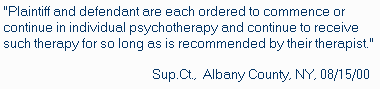 [ANONYMOUS LISTSERVE COMMENT]:
"The particular aspect of it that galled me the most was the presumption
that the custody evaluator (who then passes the ball to the Court, who
in turn stands for the State) knows what is best. Knowing what is best
seems to give the custody evaluator (thru the Court and the powers of the
State) the right/obligation to micromanage the lives of the family members.
The custody evaluator (the Court, the State) seem to make an industry of
pushing around the family like chess pieces." (New York doctorate-level
MHP, June 9, 2001). [ANONYMOUS LISTSERVE COMMENT]:
"The particular aspect of it that galled me the most was the presumption
that the custody evaluator (who then passes the ball to the Court, who
in turn stands for the State) knows what is best. Knowing what is best
seems to give the custody evaluator (thru the Court and the powers of the
State) the right/obligation to micromanage the lives of the family members.
The custody evaluator (the Court, the State) seem to make an industry of
pushing around the family like chess pieces." (New York doctorate-level
MHP, June 9, 2001).
[ANONYMOUS LISTSERVE QUERY]:
"I am doing a CCE. A parent who hasn't seen his son for two months
is angry that the child has cursed at him during one telephone call. In
the other phone call during this two months the son told the parent that
he does not want visitation. A visit is arranged. The father tells me that
at the pick up for this visit he will demand an apology from the son for
cursing at him on the phone. If the son does not apologize he will refuse
to take the son on the visit... Question: The father's plan seems very
bad. Since I am doing a CCE do I tell the father? Under what circumstances,
when you are conducting a CCE, do you tell a parent that a course of action
they are planning is not good?" (New York doctorate-level MHP, February
25, 2005).
[ANONYMOUS LISTSERVE RESPONSE]: "I
don't think its in your role to "help." Explore the reasons
why the father thinks he should do this and just listen in an evaluative
capacity." (New Jersey doctorate-level MHP, February 25, 2005).
[ANONYMOUS LSITSERVE RESPONSE]: "Custody
evaluators need not define their roles so rigidly as to hamstring themselves
from helping the situation when it won't really interfere with their primary
function. Family courts are not merely fact-finding machines. Even the
court process itself lends itself to opportunities for therapeutic jurisprudence.
Even attorney and judges in family court routinely step beyond their role
of assisting in the argument and decision of the case to lend parties much
needed advice... " (Michigan doctorate-level MHP, February 25, 2005).
[ANONYMOUS LISTSERVE RESPONSE]: "I've
had 2 cases where I offered advice, specifically thinking I wanted to assess
the parent's amenability to influence b/c I thought it might be relevant
to the ability to benefit from therapy/parent education. In one case, the
parent rejected it, revealing a deeper level of narcissism and moral rigidity
than I'd suspected. I think that was valuable evaluative knowledge.
However, in another, the parent took it, and I thought that indicated that
the parent could benefit from therapy/parent education - until I came to
understand that this was merely compliance and impression management..."
(New Jersey doctorate-level MHP, February 25, 2005).
Money,
Money, Money, mmmm-Money
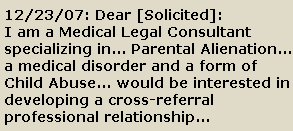 [ANONYMOUS LISTSERVE COMMENT]:
"To me a subpoena is a pay day notice." (California doctorate-level
MHP, February 4, 2007). [ANONYMOUS LISTSERVE COMMENT]:
"To me a subpoena is a pay day notice." (California doctorate-level
MHP, February 4, 2007).
[ANONYMOUS LISTSERVE CALL FOR REFERRALS]:
"I am needing three referrals. The first is a good therapist
(or several) in the Seattle area to work with the parents of a difficult
3 year old. Second, for a family in the Medford or Cherry Hills,
NJ area, I need a therapist who is familiar with alienation and reunification.
Finally, in that same geographic area, I need information on professional
supervisors for supervised visitation. Please respond back channel
if anyone has information for me." (Georgia doctorate-level MHP, March
7, 2007).
[ANONYMOUS LISTSERVE COMMENT]:
"My stips say that each attorney gets everything that is given to
me... Once the case is underway everything comes and goes through the attorneys.
Thus, is an attorney sends me something they have sent it to the other
attorney 10 working days before they sent it to me and the other attorney
has either approved it going to me, opposed it going to me and I don't
receive it until they settle their dispute, or the other attorney makes
no response, in which case it comes to me. When the clients come into my
office they sign releases that have already been reviewed by their attorneys
and I review information with them partially from questionnaires that their
attorneys also reviewed, including their client's answers...Again, part
of my stips, I ask each attorney to log the documents that they send to
me and inform them that I will use the document names they provide to list
their documents. At the end of my evaluations, before I begin my report,
I send each attorney a bibliography of everything I have done in the case,
the people I have seen, the telephone conferences, etc. and a list of all
documents separated into who provided me with what materials..." (California
doctorate-level MHP, March 17, 2007).
[Ay...
I'm exhausted just reading this. So, undoubtedly, are many parties' available
litigation funds. Money x three... or four if a GAL attorney is added in.
Yes, this is what I went to lawschool for. To make money doing clerical
work and billing time logging documents for an MHP to "review"...
Not.]
Parental
Alienation "Therapy"
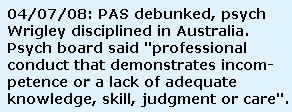 [ANONYMOUS LISTSERVE REQUEST]:
"Some time ago, around July 2004, there was a discussion on this list
about the Rachel Foundation. I would like to review some of the comments/opinions
presented in this list but cannot find the thread in the archives. If anyone
who has these emails would share them with me I would appreciate it. Or,
if any of the posters from back then would be willing to contact me back
channel, that would be helpful also." (Texas doctorate-level MHP,
March 5, 2005). [ANONYMOUS LISTSERVE REQUEST]:
"Some time ago, around July 2004, there was a discussion on this list
about the Rachel Foundation. I would like to review some of the comments/opinions
presented in this list but cannot find the thread in the archives. If anyone
who has these emails would share them with me I would appreciate it. Or,
if any of the posters from back then would be willing to contact me back
channel, that would be helpful also." (Texas doctorate-level MHP,
March 5, 2005).
[ANONYMOUS LISTSERVE COMMENT]:
"See this: http://www.rachelfoundation.org" (California
doctorate-level MHP and list moderator, February 15, 2007).
Lots
of work for three therapists... (this is extortion, brainwashing, and child
abuse, by the way)
[ANONYMOUS LISTSERVE QUERY]:
"Is there anyone out there that has reference to or a model for "reunification
treatment plans"? - maybe from a public or adoption agency?"
(Florida doctorate-level MHP, April 22, 2007).
[ANONYMOUS LISTSERVE ME TOO]:
"Please share what you learn. I have heard this term for years
and have not seen any lit. on it." (Texas doctorate-level MHP,
April 22, 2007).
[ANONYOMOUS LISTSERVE RESPONSE]:
"You might see what The Rachel Foundation For Family Reintegration
has to offer. They work with Hague Convention cases and alienation cases,
both of which involve reunification planning. I have no personal experience
with them, so I can't say if they are competent, legitimate, etc. or not."
(Missouri doctorate-level MHP, April 22, 2007, recommending what might
be incompetent and illegitimate.)
[ANONYMOUS LISTSERVE RESPONSE]: "We
do a lot of this... generally starts with a court order... result of a
thorough psychological assessment... a team approach... three psychologists
- one for each parent and one for the child(ren)... the "truth"
is irrelevant... We need to work from the child's truth as a beginning...
In the first sessions between parent and child both the child's therapist
and the estranged parent's therapist are present... the first session allows
the child to directly or indirectly (through the therapist) to express
their concern, then a break is taken where the parent is coached in how
to respond... Sessions involve two therapists until the child's therapist
is confident... for the first session(s) the child meets the parent only
in the office and is allowed to leave first... child is picked up from
school by the "estranged" parent, brought to the session, then
picked up after the session by the residential parent... the time the child
spends with the parent increases to overnights and weekends. By always
terminating the visit with a counselling session, any negative events can
be documented and the "residential" parent, if engaged in alienation
does not have a chance to re-write history before the child is seen by
a third party...." (Canadian doctorate-level MHP, April 22, 2007).
Parenting
Classes
[ANONYMOUS LISTSERVE COMMENT]:
"Our local child welfare agency is interested in revamping its typical
'parenting classes" does anyone know of a good study guide or workbook
or activities book or curriculum for a group, that might be readily available?"
(Florida doctorate-level MHP, August 27, 2005).
[ANONYMOUS LISTSERVE COMMENT]:
"I think it is truly unfortunate that more quality resources do not
exist for more families - in health care, parenting classes, child care,
therapy, all kinds of things... " (California doctorate-level MHP,
March 5, 2006).
Parenting
Coordination
[ANONYMOUS LISTSERVE COMMENT]:
"The NJ Chapter of the Association of Family and Conciliation Courts
has been promulgating a rule (Proposed Parenting Coordinator Rule 5:8-7)
requiring the appointment of parenting coordinators in certain types of
cases." (New Jersey doctorate-level MHP, December 8, 2004).
[Over
a 24-month period, there were 1282 posts of a total of 14,274 that included
the term "parenting coordination", "parenting coordinator",
or "PC", nearly a fifth of which also included the term "AFCC"
(or referred to related organizations), and many of which discussed legislation,
lobbying, development of guidelines, and similar political activity...
and it continues, below, attempting to figure out how to claim that research
shows what a good idea it is...]
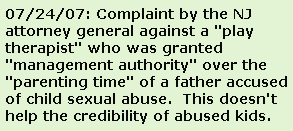 [ABA
FAMLAWESQ LISTSERVE]: "Is anyone aware of any study(ies) done in any
jurisdiction by any entity that addresses the effectiveness or success
of parenting coordination? We proponents of parenting coordination
in New Hampshire continue to run into skepticism and foot-dragging by the
legislature. At a legislative committee hearing held today on our
parenting coordinator bill (attended by three AFCC-trained and practicing
PC's, two of whom, including me, gave testimony), we were told that the
committee would need copies of studies regarding the effectiveness of parenting
coordination, or at the very least strong, credible anecdotal material."
(New Hampshire family lawyer, forwarded to the anonymous listserve by a
California lawyer, March 8, 2007). [ABA
FAMLAWESQ LISTSERVE]: "Is anyone aware of any study(ies) done in any
jurisdiction by any entity that addresses the effectiveness or success
of parenting coordination? We proponents of parenting coordination
in New Hampshire continue to run into skepticism and foot-dragging by the
legislature. At a legislative committee hearing held today on our
parenting coordinator bill (attended by three AFCC-trained and practicing
PC's, two of whom, including me, gave testimony), we were told that the
committee would need copies of studies regarding the effectiveness of parenting
coordination, or at the very least strong, credible anecdotal material."
(New Hampshire family lawyer, forwarded to the anonymous listserve by a
California lawyer, March 8, 2007).
[ANONYMOUS LISTSERVE RESPONSE]: "___,
Ph.D., although not on the list, teaches workshops on PC and
would probably be a good resource for your question." (California
doctorate-level MHP, March 8, 2007).
[ANONYMOUS LISTSERVE RESPONSE]: "...I
actually copied him on the message to the listserv. Great minds think alike
: ) " (the same California lawyer, March 8, 2007).
[ANONYMOUS LISTSERVE RESPONSE]: "We
have some local data since the passage of the NC Statute on parenting coordination.
I will see what shape it is in at this time. Please contact me back
channel if you want me to pursue this." (Washington doctorate-level
MHP, March 8, 2007, who -- liz's guess -- has either anecdotal bullshit
or else lobbying talking points, because if she actually had research she
would have posted it to the anonymous listserve).
[ANONYMOUS LISTSERVE RESPONSE]: "The
first PC statute was birthed in the Tulsa County (Oklahoma) domestic court. Data
was gathered and summarized after one year of implementation. Interestingly,
the criteria for determining "success" was whether the PC
program reduced the number of motions to modify filed as compared to the
previous year. The data was never published but presented at local
gatherings (and may be available). The PC model was highly successful
in accomplishing this task. Anecdotally, PC's reported dramatic improvements
in post divorced couples ability to reduce conflict and cooperate. A major
revision in the statute and new group of judges (not originally invested
in the model) resulted in a significant reduction in the number of cases
assigned to PCs, and only the most highly conflictual (i.e., least
appropriate) were being referred. Consequently, the PC program 'ain't
what it used to be.'" (Oklahoma doctorate-level MHP, March 8, 2007).
(In other words, it doesn't work so hot.)
[ANONYMOUS LISTSERVE COMMENT]:
"The "practice of psychology" and "Parenting Coordinator"
are defined by separate statutes in Oklahoma. While some board members
may believe that they are the same, the statutory definitions are... different...
role of the PC is to "hear and decide issues..." and may be a
mental health professional, attorney, anyone mutually agreed upon...
There is nothing in the statutory definition of PC that falls within the
statutory definition of the practice of psychology... I am appalled with
the mind set of previous posts taking the position that the practice of
PC should be considered the practice of psychology so that our malpractice
insurance will cover it!" (Oklahoma doctorate-level MHP, April 17,
2007).
Parenting
Conjoint Therapy
[ANONYMOUS LISTSERVE QUERY]:
"If it is in fact ordered, is there something that should also be
included in the recommendation that helps the court to monitor the follow
through? With parenting classes there is often a certificate to demonstrate
completion. If therapy were ordered per the recommendation would the evaluator
recommend the therapist send a report to the court that would state dates
of attendance, cooperation, prognosis without giving any details? Is there
a way it should be worded that would make it enforceable?" (California
doctorate-level MHP, May 27, 2004).
Reunification
Therapy, and Just Plain Old Relationship Therapy
[ANONYMOUS LISTSERVE OBSERVATION]:
"...the problem is that if there is insufficient contact between the
child and the parent with whom he or she has a difficult relationship,
treatment is doomed before it begins. The missing data here is what interventions
have been attempted to date, what the parents have tried, and what the
results have been. Availability of resources is a real issue, and it should
be considered in framing interventions. The other side of the coin should
also be considered - i.e., whether a change in the custody plan will make
it more or less likely that any intervention can be effective." (California
doctorate-level MHP, May 27, 2004).
Treating
Children Who Resist Visitation Because of Parental Defects
[ANONYMOUS
LISTSERVE INQUIRY]: "Does anyone have any references for treatment
for children when they are they are resisting visitation because a parent
has been emotionally abusive? The children are 16 and 13.
When does it become abusive to continue to force children into contact
or therapy at that age? ...This is 6 years post-divorce." (Vermont
doctorate-level MHP, January 14, 2007).
[What
happened to the best interests of the child? This evaluator just wants
to insure she doesn't recommend something her peers might consider to be
"abusive".]
[ANONYMOUS LISTSERVE
PONTIFICATING or blathering re two teenagers who have been refusing to
visit with emotionally abusive noncustodial parent]: "Jan Johnston
presented at an AFCC-CAL a couple of years ago, with some of her outcome
studies re alienation... supervised visitation and the kinds of protection...
limit-setting of the parent by the therapist... We've also done some work
on that issue... the developmental literature on coping skills, i.e. that
kids and adolescents need to learn to resolve emotional issues by active
engagement with others, rather than avoidance. Dunn (2000, I think)...
active participants in decisions about their lives... distinguished from
being given the power over decisions. Kelly's article on Risk and
Resilience... If the therapist knows how to do conjoint, and is sufficiently
protective that the parent doesn't get to "emotionally abuse"
the kids in the therapy setting... skills they will need to deal with difficult
people throughout their lives... one study that suggested that kids need
to learn how to resolve problems assertively within their intimate relationships;
learning to assert themselves at school is not a substitute. (I think
that's Feilds and Prinz.) Is Dad in treatment? Is parent education
ongoing? Is the adolescents' resistance a matter of wanting to escape
a currently abusive or pathologic situation, or has Dad changed, but the
kids remain mired... 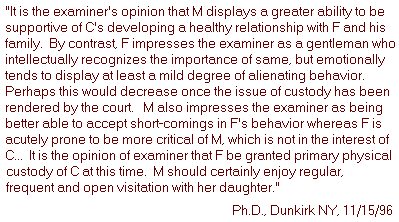 How
are they making decisions on other issues? Is their behavior developmentally
on target ... emotional independence and decisionmaking, or are they aligned
with the other parent... little literature on this area... an article with
the specific title, "children who refuse visitation," but at
this moment I can't place the reference - I think it was in FCR.
Our treatment models are based on the literature... behaviorally and cognitively
based - those are the models that have shown better effects with the craziest
parents. A vital issue, IMHO, is that the conjoint therapist set
sufficient limits with the parent from the beginning, and with the children
if they engage in developmentally inappropriate behavior... I'm emailing
you some references back channel. I'd also check with Jay Lebow at
Northwestern." (California doctorate-level MHP who gets a lot of referral
"reunification therapy" work from the court system, January 14,
2007). How
are they making decisions on other issues? Is their behavior developmentally
on target ... emotional independence and decisionmaking, or are they aligned
with the other parent... little literature on this area... an article with
the specific title, "children who refuse visitation," but at
this moment I can't place the reference - I think it was in FCR.
Our treatment models are based on the literature... behaviorally and cognitively
based - those are the models that have shown better effects with the craziest
parents. A vital issue, IMHO, is that the conjoint therapist set
sufficient limits with the parent from the beginning, and with the children
if they engage in developmentally inappropriate behavior... I'm emailing
you some references back channel. I'd also check with Jay Lebow at
Northwestern." (California doctorate-level MHP who gets a lot of referral
"reunification therapy" work from the court system, January 14,
2007).
[Don't
13- and especially 16-year-old children have better things to do -- such
as pursue their studies, extracurricular activities, social life -- than
to have to put up with this pointless time-wasting, enervating nonsense,
this ridiculous unending goal-less relationship engineering and intrusive
meddling, merely because 6 years before their parents got divorced? What
inner demons, childhood issues, or personal foibles drive some (fortunately
not all) of these arrogant, nosy, gossipping, self-important, plodding,
interloping, and/or power-mongering, snake-oil purveyors and psychic vampires?
Or is it just greed, and inability to earn a living in some productive
way.]
Treating
Perpetrators
[ANONYMOUS LISTSERVE REQUEST]:
"I'm looking for outcome research on 52 week DV treatment programs
(also referred to as batterers treatment programs), which are frequently
referred to in California. Any references would be appreciated." (California
doctorate-level MHP, October 5, 2005).
[ANONYMOUS LISTSERVE COMMENT]:
"...I have on occasion given an attorney one of the few articles on
treatment so that they will formulate a therapy order..." (California
doctorate-level MHP, December 18, 2005).
[NOTSOANONYMOUS LISTSERVE COMMENT]:
"Interesting to see that the same old flawed studies are still being
trotted out in support of a "therapy" which continues to lack
any scientific support... I would like to address parole boards sometimes
and ask them "Do you think that attendance on a suitably designed
course could turn you into pedophiles? Well, it won't work the other way
round, either!" (Doctorate-level MHP, March 20, 2007).
[NOTSOANONYMOUS LISTSERVE RESPONSE]:
" Losel conducted a meta-analysis of 69 studies containing 80 individual
comparisons between treated and untreated offenders. The majority of effect
sizes confirmed the benefits of treatment. The mean rate of sexual recidivism
is 11.1% in treated and 17.5% in comparison groups. Given the low base
rate of sexual recidivism is taken into account this is equivalent to a
reduction of nearly 37%... Losel, F & Schmucker, M. (2005). The effectiveness
of treatment of sexual offenders: A comprehensive meta-analysis. Journal
of Experimental Criminology, 1, 117-146." [FOLLOWUP]: "The goal
of treatment of pedophiles is not for them not to be pedophiles, it is
to be able to manage their behavior and not act out on their deviant interests."
(Iowa doctorate-level MHP, March 20, 2007). (At best a 66% chance that
the pedophile can't -- or won't -- control his behavior... is success?)
Treating
Victims and...
[ANONYMOUS LISTSERVE COMMENT]:
"This is where I think the DV debate sometimes becomes destructive.
I didn't read ___'s message as saying that DV, if it exists, is the victim's
fault. She just said that it would be important to assess the woman's issues
as well as the man's. This reminds me of the debate which sometimes occurs
re whether evaluators should recommend that both parents be ordered into
treatment if one has been a "victim" of DV...The argument I heard
at AFCC was that requesting that both parents be ordered into treatment
suggests that both have equal responsibility for the violence when in fact
one party (i.e. the male) may be more responsible. Some suggest that the
woman should only be strongly urged to seek treatment voluntarily. My concern
about this position is that if the woman decides that there's "nothing
wrong with her" and declines to seek treatment, her issues may remain
unaddressed and she may reinforce a victimization perspective in the kids."
(California doctorate-level MHP, June 3, 2001). [Speculation?]
...When
There Still Isn't Enough Work, Doing Trainings for Everyone (especially
those that push make-work ideas) and Reviewing Other MHPs
[ANONYMOUS LISTSERVE COMMENT]:
"I do CCEs and I function as a court-appointed "Case Manager"
in Kansas. Kansas calls parent coordinators "Case Managers" to
avoid confusion - lol. I have also twice attended AFCC sponsored training
on parent coordination. The Colorado group (Christie Coates, Robert LaCrosse,
And Betsy Duvall) did a 2 day training in St. Louis in November, 2003,
and Joan Kelly did a 2 day training in Chicago in June 2004. Both of these
training programs emphasize the "Divorce Impasse" Model that
Janet Johnston put together. This is a model that I find helps in CCEs
and parent coordination/case management. The second AFCC task force has
just completed its task of developing model standards for parent coordinators
(See AFCC website or request backchannel)..." (Kansas doctorate-level
MHP, May 16, 2005).
[ANONYMOUS LISTSERVE QUESTION]:
"Is anyone aware of the following folks or organization? Have they
appeared elsewhere? I am contemplating attending of only to find out how
the construct is currently being packaged and sold. Cost of the workshop
is $85 pre-registration, $100 at the door. Space is limited and pre-registration
is recommended. The workshop will consist of a structured lecture type
presentation in the morning, followed by an interactive discussion and
question and answer period in the afternoon. We will cover topics on parental
alienation, suggestability, false memory, and the reunification process.
Attendees are encouraged to submit their questions beforehand... http://www.parental-alienation-awareness.com/
" (Florida doctorate-level MHP, April 14, 2006).
[ANONYMOUS LISTSERVE RESPONSE]: "Gag.
Look at the "articles" page. This kind of thing makes it that
much harder to get a real problem taken seriously..." (California
doctorate-level MHP, April 14, 2006).
[ANONYMOUS LISTSERVE IDEA]:
"I would like to propose that those of us who participate in the family
law area organize a concerted effort to foster among judges... there are
too many child development issues and too many parent conflict issues involved
in family law cases that are often poorly dealt with by the court because,
in large part, because the judges do not have the requisiste training.
Access schedules for infants that are based on every other weekend is one
example. We need to create an awareness that the country as a whole needs
to expect that family law judges understand the psychological dynamics
presented to them in family law cases because without such understanding,
we run the risk of hurting children." (North Carolina doctorate-level
MHP, September 26, 2007, who in the opinion of the author of this webpage
holds preferences for joint custody that are not all grounded in research.)
[ANONYMOUS LISTSERVE COMMENT]: "The
Family division of the Bar might also have some investment in Judges training
and education. I like this idea. Would be nice for such training be a required
CLE as is often required occasionally for some MHP." (Florida doctorate-level
MHP, September 26, 2006).
[ANONYMOUS LISTSERVE RESPONSE]: "I
think we're [that includes me] being pretty damn arrogant to suggest that
another profession should have better training when the training of many
custodial evaluators is sooo poor, it's embarrassing...when evaluators
tell the Court, "there's no requirement that I do collaterals or review
records", I want to puke -- like the Billy goat from a few posts ago...
So...when we get our house in order, then we can start telling other professions
how they should be trained..." (Florida doctorate-level MHP, September
26, 2006).
[ANONYMOUS LISTSERVE COMMENT]:
"As I do more and more review work, I'm thinking I need a Consent/Statement
of Understanding/Stipulation/etc specific to that purpose. Does anyone
have one they would be willing to share?" (Missouri doctorate-level
MHP, March 19, 2007).
[ANONYMOUS LISTSERVE RESPONSE]: "Ooooh,
I'd like one too." (Indiana doctorate-level MHP, March 19, 2007).
[ANONYMOUS LISTSERVE RESPONSE]: "Me,
too...and I'll bet we're not the only three! Perhaps those willing
to share should..." (Indiana doctorate-level MHP, March 19, 2007).
[ANONYMOUS LISTSERVE FOLLOWUP]: "I
think it would be wise to start out with a statement that describes
the role of a reviewer and differentiates it clearly from other
roles -- especially from that of a second opinion evaluator! I have
seen a couple of cases in which someone was hired as an "expert"
in what appeared to be the role of a reviewer, who then administers a couple
of tests or otherwise attempts to perform some "corrective surgery"
on what the reviewer believed to be the weak points of the original evaluation..."
(Indiana doctorate-level MHP, March 20, 2007).
[ANONYMOUS LISTSERVE COMMENT]:
"I am a psychologist... with a practice focused on high conflict divorce
and child protection issues. I have done child custody and child protection
evaluations for about twenty years... I work as a Parenting Coordinator...
I teach Law Students in the..., helping insure that the they learn what
is and is not a good court-ordered evaluation. I like thinking about attachment
issues in the children of divorce and personality disorders in their parents."
(Michigan doctorate-level MHP, March 25, 2007).
THERAPEUTIC JURISPRUDENCE...
[ANONYMOUS LISTSERVE COMMENT]:
"Judges sometimes want to "get the ball rolling" with a
few therapeutic contacts. They may figure that (1) the therapist will ask
for more if necessary; (2) the therapist will magically make everyone "play
nice; " (3) the visit supervisor will "take over" after
the therapeutic contacts; or (4) there really isn't a problem anyway so
once visits get going, it won't be an issue; or (5) this is the best they
can do to get these people to shut up and let the court move on to the
next case, and hopefully the therapist will come up with something that
allows the judge (or hopefully, some other judge) to make a longer-term
decision next time. They don't understand that treatment can be impacted
from early on based on how long the therapist expects to have with the
child. You don't open a kid up in sessions 1-3 if you think that there
are only going to be 4 sessions, or you risk harm to the child." (California
doctorate-level MHP, July 16, 2005).
"Do
a Bonding Assessment"
[ANONYMOUS
LISTSERVE COMMENT]: "I do not know of a research based protocol
for a 'bonding assessment.' It seems the folks that do them around
here do an observation of touching, smiling, eye contact, warm interactions
etc which are good and important and look at basic needs and are they met.
I was wondering if there are protocols that are considered 'standard of
care' and or are reseach based." (Kansas doctorate-level MHP, January
14, 2007.)
[ANONYMOUS LISTSERVE RESPONSE]: "The
only formalized protocol I can think of is the 'Strange Situation' (Ainsworth,
1978). That is, if you are defining 'bonding' as equivalent to 'attachment'
-- we didn't get a definition of what your court/attorneys/whatever were
using for the phrase 'bonding assessment' which I've seen have various
meanings. A couple of problems that I can think of: first getting certified
in the Strange Situation protocol is apparently not an easy process; second,
you didn't mention how old the kids involved are, but beyond the first
few years of age you have a number of confounding variables to deal with...
My question would be what functional behaviors is the court asking you
to assess? What are the underlying questions that the court is looking
for answers to? Most poignant anecdotal example I've ever run into
was an multigenerational incest case... kids just assumed their (highly
damaging) lifestyle was 'normal.' The kids actually appeared more attached/bonded
to the father, as he was relatively attentive to their needs (as long as
he was out of jail and they were willing to perform sex acts with him),
especially in comparison to mother, who was generally neglectful... If
we hadn't intercepted some of dad's letters to the kids from jail you might
have actually thought he was a better placement option than mom."
(Texas doctorate-level MHP, January 14, 2007).
[Note
that the deciding factor in the above example had nothing to do with psych
expertise. One also reasonably might ask why the court in the responder's
case was having such difficulty making a custody placement decision that
an MHP had to be appointed if notwithstanding the allegations against the
mother (presumably not bad enough to warrant foster care placement), the
father was a repeat convict who frequently was not even around.]
"Do
a Psycho-Sexual Evaluation"
[ANONYMOUS LISTSERVE INQUIRY]:
"A judge recently ordered a litigant for a psychosexual evaluation...
are there codified standards of practice dictating the contents of a 'psychosexual
eval'?" (Florida doctorate-level MHP, January 15, 2004).
[ANONYMOUS LISTSERVE RESPONSE]: "I
would consult the APSAC guidelines on psychosocial evaluation of kids alleged
to have been abused and other related APSAC guidelines... " (North
Carolina doctorate-level MHP, January 15, 2004).
[ANONYMOUS LISTSERVE RESPONSE]: "I'd
actually like to have a definition of what is a "psychosexual evaluation"
(Another Florida doctorate-level MHP, tongue-in-cheek, January 15, 2004).
[ANONYMOUS
LISTSERVE COMMENT]: "I would never presume to render an opinion about
whether or not sexual abuse occurred. I always present the factors in support
and the factors that seem to suggest otherwise, and let the judge make
the decision. I do have a great deal of experience in evaluating sex offenders,
so would probably use my own expertise in that area. I've worked with and
evaluated sex offenders since 1977 & am involved in ongoing research
with sex offenders and the Rorschach." (California doctorate-level
MHP, July 11, 2004).
Erroneous
Belief in Benefit Where None Exists.
Isn't it Time We Ditched this Bad
Idea? (article)
Also see therapeutic
jurisprudence index.
Recommended off-site read:
 (No.)
(No.)
[ANONYMOUS LISTSERVE
ADVISORY]: "Thanks for the very focused and helpful response to the
issues we are struggling with. I have been sharing the responses with
my client as I receive them. Does anyone else have anything to add
or does anyone else strike the balance differently?" (California lawyer,
June 9, 2001).
NOTICE:
This work is part of an ongoing research project investigating
the workings of our justice system. Empirical data is still being compiled
and analyzed. Claims that quotes have been taken out of context, altered
or fabricated, or are not representative, or any other actionable defamation
or other act interfering with or impugning this research before findings
are published in a refereed scientific journal will be defended by, inter
alia, the placing of the original data into the public domain.
Who cites
to us? Here are a few examples::
http://law.bepress.com/cgi/viewcontent.cgi?article=1502&context=alea
(law journal)
http://www.firstladies.org/curriculum/curriculum.aspx?Curriculum=961
(historical organization)
http://www.historynow.org/03_2006/print/lp2.html
(historical society)
http://tinyurl.com/2ylylq Common
Core and Better Law in European Family Law (law
treatise)
http://research.umbc.edu/~korenman/wmst/patriarchy2.html
(college women's studies)
http://www.aaml.org/files/public/Journal_vol_19-2-7_Review_of_Research...Relocation.pdf
(law journal)
http://tinyurl.com/2kenhs How
To Parent With Your Ex: Working Together... (book
on divorce)
http://www.leadershipcouncil.org/1/pas/2.html
(scientific organization website)
http://www.tantasqua.org/superintendent/curricula/HistorySocialSciences/
(public school curriculum)
http://tinyurl.com/2o6v9w The
Battle And Backlash Rage On (book on feminism)
The ABA Family Law Quarterly
(law journal)
RETURN TO TOP
|
